FREE KINDLE FOR PC

FREE KINDLE FOR PC
So you can read my books
Showing posts with label EMILY DICKINSON. Show all posts

Wednesday, September 21, 2016

THE SOUL SELECTS HER OWN COMPANY


I was sitting alone at my table in the darkened Meilori's. The light of my laptop showed the dismal numbers of those who have bought my books this month.

Fingertips pressed softly on my shoulder.  "May this wayward soul sit down?"

I looked up.  Emily Dickinson, dressed in a black Victorian dress, stood smiling sadly at me.


Her voice was gentle, low, and caring.  I smiled back.  "Of course."

I got up and pulled out the chair for her.  She flowed down into as lady-like ghosts often do here at Meilori's.

As I sat back down, Emily slid a small volume to me.  Its cover was dark and light lavender.  Its simple title: POEMS ~ Emily Dickinson.

"This first volume of my poetry appeared on this day in 1890, two years after my death.  

My early editors, the critic Thomas Higginson and family friend Mabel Loomis Todd, made many changes in an effort to make my poems more 'conventional,' but these had not allayed the priggish critics."

 Emily picked up the volume from in front of me and read one of her "versicles" as her critics called them:

"The soul selects her own society,
Then shuts the door;
On her divine majority
Obtrude no more.

Unmoved, she notes the chariot's pausing
At her low gate;
Unmoved, an emperor is kneeling
Upon her mat.

I've known her from an ample nation
Choose one
Then close the valves of her attention
Like stone.
"

Emily withdrew a folded newspaper clipping from her dress pocket.

"I told others that my critics bothered me not.  But here is the lie: this aged review by Thomas Bailey Aldrich from THE ATLANTIC MONTHLY of January, 1892.  It reads as follows:

'But the incoherence and formlessness of her — I don't know how to designate them — versicles are fatal…. 

An eccentric, dreamy, half-educated recluse in an out-of-the-way New England village (or anywhere else) cannot with impunity set at defiance the laws of gravitation and grammar.'"

Her hand gently covered mine.  "You are of worth, young sir, because you care.  Your prose is of worth if only one soul is uplifted because of it."

Emily smiled, “I know nothing in the world that has as much power as a word. Sometimes I write one, and I look at it, until it begins to shine.  I read one of yours and it does the same."

Her eyes sparkled,   “We turn not older with years but newer every day.  You are newer today than yesterday for you have suffered, you have learned -- so you are a new you."


The ghost of Mark Twain sat down beside me with a laugh.


 "Besides, son, where are those critics of Miss Dickinson here now?  Who do folks remember?  Emily Dickinson or that Thomas Bailey Aldrich?"

He winked at Emily who blushed, and he grinned,
"I believe that the trade of critic, in literature, music, and the drama, is the most degraded of all trades, and that it has no real value--certainly no large value...

However, let it go. It is the will of God that we must have critics, and missionaries, and congressmen, and humorists, and we must bear the burden."

Emily scolded him.  "That is all very well and good, Samuel, but what about your feelings for poor Miss Jane Austen?"

Mark looked like he had bitten into a slug.  "Agh!  You're right, of course.  I haven't any right to criticize books.  And I don't do except when I hate them!"

He rubbed his face. 


"I often want to criticize Jane Austen it is true.  But, Lordy, her books madden me so that I can't conceal my frenzy from the reader.  Therefore I have to stop every time I begin."

He took out a cigar and lit it as Emily's nose wrinkled in distaste and went on, 


"Everytime I read PRIDE AND PREJUDICE I want to dig her up and beat her over the skull with her own shin-bone!"  

Emily gently removed the cigar from his mouth, putting it out defiantly.  "It is so heartening to see how you have mellowed with age, Samuel."

He glared at me.  "Now, you see why gentlemen are a dying breed, Roland."

"Or at least a smokeless one," I smiled.

Tuesday, November 12, 2013

THE SOUL SELECTS HER OWN COMPANY


I was sitting alone at my table in the darkened Meilori's. The light of my laptop showed the dismal numbers of those who have bought my books this month.

Fingertips pressed softly on my shoulder.  "May this wayward soul sit down?"

I looked up.  Emily Dickinson, dressed in a black Victorian dress, stood smiling sadly at me.


Her voice was gentle, low, and caring.  I smiled back.  "Of course."

I got up and pulled out the chair for her.  She flowed down into as lady-like ghosts often do here at Meilori's.

As I sat back down, Emily slid a small volume to me.  Its cover was dark and light lavender.  Its simple title: POEMS ~ Emily Dickinson.

"This first volume of my poetry appeared on this day in 1890, two years after my death.  My early editors, the critic Thomas Higginson and family friend Mabel Loomis Todd, made many changes in an effort to make my poems more 'conventional,' but these had not allayed the priggish critics."

 Emily picked up the volume from in front of me and read one of her "versicles" as her critics called them:

"The soul selects her own society,
Then shuts the door;
On her divine majority
Obtrude no more.

Unmoved, she notes the chariot's pausing
At her low gate;
Unmoved, an emperor is kneeling
Upon her mat.

I've known her from an ample nation
Choose one
Then close the valves of her attention
Like stone.
"

 
Emily withdrew a folded newspaper clipping from her dress pocket.
 
"I told others that my critics bothered me not.  But here is the lie: this aged review by Thomas Bailey Aldrich from THE ATLANTIC MONTHLY of January, 1892.  It reads as follows:
 
'But the incoherence and formlessness of her — I don't know how to designate them — versicles are fatal….
 
An eccentric, dreamy, half-educated recluse in an out-of-the-way New England village (or anywhere else) cannot with impunity set at defiance the laws of gravitation and grammar.'"
 
Her hand gently covered mine.  "You are of worth, young sir, because you care.  Your prose is of worth if only one soul is uplifted because of it."
 
Emily smiled, “I know nothing in the world that has as much power as a word. Sometimes I write one, and I look at it, until it begins to shine.  I read one of yours and it does the same."
 
Her eyes sparkled,   “We turn not older with years but newer every day.  You are newer today than yesterday for you have suffered, you have learned -- so you are a new you."


The ghost of Mark Twain sat down beside me with a laugh.

  "Besides, son, where are those critics of Miss Dickinson here now?  Who do folks remember?  Emily Dickinson or that Thomas Bailey Aldrich?"
 
He winked at Emily who blushed, and he grinned,
 
"I believe that the trade of critic, in literature, music, and the drama, is the most degraded of all trades, and that it has no real value--certainly no large value...
 
However, let it go. It is the will of God that we must have critics, and missionaries, and congressmen, and humorists, and we must bear the burden."
 
Emily scolded him.  "That is all very well and good, Samuel, but what about your feelings for poor Miss Jane Austen?"
 
Mark looked like he had bitten into a slug.  "Agh!  You're right, of course.  I haven't any right to criticize books.  And I don't do except when I hate them!"
 
 
He rubbed his face. 

"I often want to criticize Jane Austen it is true.  But, Lordy, her books madden me so that I can't conceal my frenzy from the reader.  Therefore I have to stop every time I begin."
 
He took out a cigar and lit it as Emily's nose wrinkled in distaste and went on, "Everytime I read PRIDE AND PREJUDICE I want to dig her up and beat her over the skull with her own shin-bone!" 
 
Emily gently removed the cigar from his mouth, putting it out defiantly.  "It is so heartening to see how you have mellowed with age, Samuel."
 
He glared at me.  "Now, you see why gentlemen are a dying breed, Roland."
 
"Or at least a smokeless one," I smiled.
 

Sunday, November 10, 2013

TO THOSE OF US NEVER TO BE PUBLISHED_EMILY DICKINSON, GHOST

{"Publication - is the auction of the Mind of Man."
~Emily Dickinson.}

That fabulous scamp of a gentlemen, Samuel Clemens, asked me to write in this "computer newspaper," as he calls it.

The dear somehow knew this date was important to me.

“Success is counted sweetest” was published anonymously in an anthology titled A Masque of Poets on this day in 1878,

the last of the handful of my poems published in my lifetime.

Though I remained firm in my decision that “My Barefoot-Rank is better,” this poem does reflect my continued mixed feelings about publishing:

Success is counted sweetest By those who ne'er succeed. To comprehend a nectar Requires sorest need.

Not one of all the purple host Who took the flag to-day Can tell the definition, So clear, of victory!

As he, defeated, dying,On whose forbidden ear

The distant strains of triumphBurst agonized and clear!
**
I wonder, struggling souls, what would it mean to you if you were never published?

To see the Summer Sky
Is Poetry, though never in a Book it lie -
True Poems flee.

***
How long would you continue to write should publication elude you? Are the words burning within you to find life on the page?

For me, I never stopped writing:

HOPE is the thing with feathers
That perches in the soul,
And sings the tune without the words,
And never stops at all,

And sweetest in the gale is heard;
And sore must be the storm
That could abash the little bird
That kept so many warm.

I've heard it in the chilliest land
And on the strangest sea;
Yet, never, in extremity,
It asked a crumb of me.


Will you stop writing if the years pass, leaving you unpublished? 


Why? 

And if you would continue, why? This tender spirit would like to know.

Just walk out into the sable night, look up into the listening stars, and whisper your answer to the wayfaring winds. I am a ghost. I shall hear.
***

Thursday, August 16, 2012

TO THOSE NEVER TO BE PUBLISHED_ghost of EMILY DICKINSON

*
{"Publication - is the auction of the Mind of Man."
~Emily Dickinson.}

That fabulous scamp of a gentlemen, Samuel Clemens, asked me to write in this "computer newspaper," as he calls it.

The dear somehow knew this date was important to me.

“Success is counted sweetest” was published anonymously in an anthology titled A Masque of Poets on this day in 1878,

the last of the handful of my poems published in my lifetime.

Though I remained firm in my decision that “My Barefoot-Rank is better,” this poem does reflect my continued mixed feelings about publishing:

Success is counted sweetest

By those who ne'er succeed.

To comprehend a nectar Requires sorest need.

Not one of all the purple host

Who took the flag to-day

Can tell the definition, So clear, of victory!

As he, defeated, dying,

On whose forbidden ear

The distant strains of triumph

Burst agonized and clear!


**
I wonder, struggling souls, what would it mean to you if you were never published?

To see the Summer Sky
Is Poetry, though never in a Book it lie -
True Poems flee.


***
How long would you continue to write should publication elude you? Are the words burning within you to find life on the page?

For me, I never stopped writing :

HOPE is the thing with feathers
That perches in the soul,
And sings the tune without the words,
And never stops at all,

And sweetest in the gale is heard;
And sore must be the storm
That could abash the little bird
That kept so many warm.

I've heard it in the chilliest land
And on the strangest sea;
Yet, never, in extremity,
It asked a crumb of me.


Will you stop writing if the years pass, leaving you unpublished? Why? And if you would continue, why? This tender spirit would like to know.

Just walk out into the sable night, look up into the listening stars, and whisper your answer to the wayfaring winds. I am a ghost. I shall hear.

{THE LAST SHAMAN is #15 on Amazon's Best Selling Native American Fantasy list.}

*{Daguerreotype of the poet Emily Dickinson, taken circa 1848. (Original version.)

From the Todd-Bingham Picture Collection and Family Papers, Yale University Manuscripts & Archives Digital Images Database,

Yale University, New Haven, Connecticut.

This image (or other media file) is in the public domain because its copyright has expired.

This applies to Australia, the European Union and those countries with a copyright term of life of the author plus 70 years.}


***


Wednesday, June 27, 2012

WHY DO YOU WRITE?


We write.

We strive.

We bleed the ink the page before us has been needing.

And for what?

That answer determines the manner in which we write :

hurried to meet some self-set goal

or

focused like light through the prism of our soul to cast the light of our dreams

onto an imagined page some unknown reader will read, becoming lost in our imagined worlds :


"To get the right word in the right place is a rare achievement.

To condense the diffused light of a page of thought into the luminous flash of a single sentence,

is worthy to rank as a prize composition just by itself...

Anybody can have ideas--

the difficulty is to express them without squandering a quire of paper on an idea that ought to be reduced to one glittering paragraph."

- Mark Twain in a letter to Emeline Beach, 10 Feb 1868.


Will we be understood?

Thomas Bailey Aldrich, in a review of Emily Dickinson’s poetry published anonymously in the Atlantic Monthly, January, 1892 :

"But the incoherence and formlessness of her —

I don't know how to designate them — versicles are fatal….

An eccentric, dreamy, half-educated recluse in an out-of-the-way New England village (or anywhere else) cannot with impunity set at defiance the laws of gravitation and grammar."

Whose name is familiar to you : the poet's or the reviewer's?

Hope is the thing with feathers
That perches in the soul,
And sings the tune without the words,
And never stops at all,

- Emily Dickinson


Have you noticed that much of the fiction out there has become more and more stylised, more and more cut off from ordinary feeling?

Is it that so many have come to regard everything in the world around us as fiction.... All the structures in it, flyovers and motorways, office blocks and factories, are all part of this enormous novel.

And since all those around us are mere backdrop in the fiction of our lives, they cease to become living, hurting, feeling individuals.

Ernest Hemingway wrote :

"Writing, at its best, is a lonely life.

Organizations for writers palliate the writer's loneliness, but I doubt if they improve his writing.

He grows in public stature as he sheds his loneliness and often his work deteriorates.

For he does his work alone and if he is a good enough writer he must face eternity, or the lack of it, each day.

You know that fiction is possibly the roughest trade of all in writing.

You do not have the reference, the old important reference.

You have the sheet of blank paper, the pencil, and the obligation to invent truer than things can be true.

You have to take what is not palpable and make it completely palpable and also have it seem normal and so that it can become a part of experience of the person who reads it."


Why do you write?

To touch one human heart?

To impress someone who may not even be alive, or if alive, does not see you as your dreams and soul truly are?

To make the bestseller lists?

To become wealthy and famous? To support yourself comfortably?

To tell the stories that burn to come out and sigh in relief as you type them into being?

Why we write determines how we write and how much pleasure we derive from it/

What do you think?

Thursday, June 7, 2012

THIS IS THE MOMENT

This is the moment.

What moment?

The only one we have.

And it speeds by so quickly it is gone before we can reach out and grasp it.


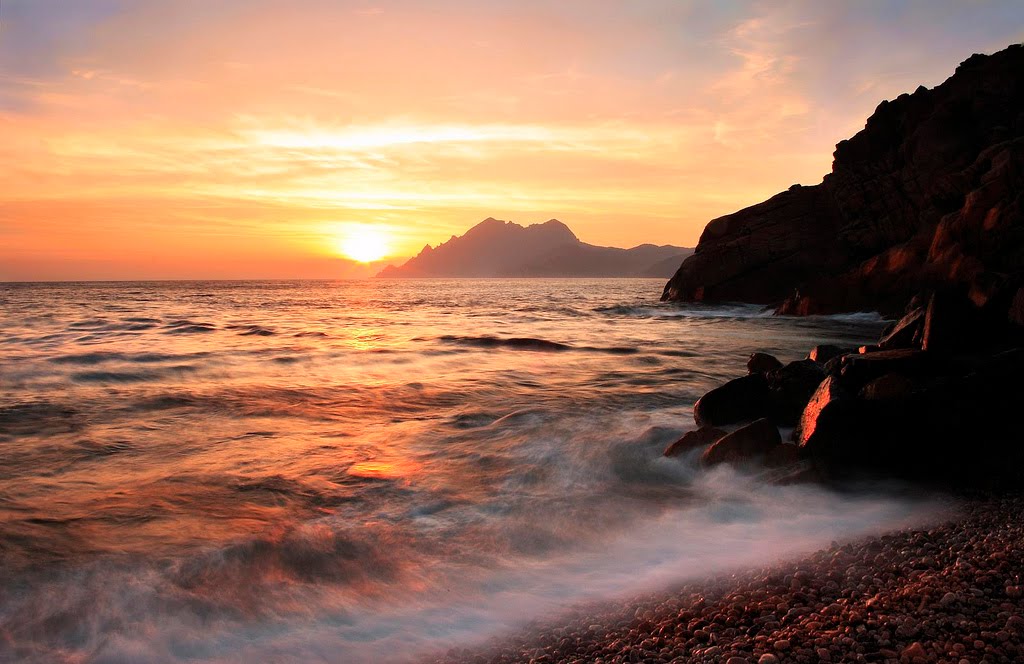
See? It is already gone : that moment when your eyes first spied that sunset over Corsica.

And that is why my half-Lakota mother murmured to me as we looked out over Lake Michigan on that frosty sunset of so long ago :

"Breathe each breath, little one. No two are the same.

Remember the colors that paint this sky. Remember me, little one. Remember, and neither the sunset nor I will ever leave you. Ever."


On this day in 1864, Emily Dickinson's "Blazing in Gold" was first published. Here is a snippet :

"Blazing in gold and quenching in purple,
Leaping like leopards to the sky,
Then at the feet of the old horizon
Laying her spotted face to die…."

And from Christina Georgina Rossetti comes this bit from "From Sunset To Star Rise" :

"I live alone, I look to die alone:
Yet sometimes, when a wind sighs through the sedge,
Ghosts of my buried years and friends come back,
My heart goes sighing after swallows flown
On sometime summer's unreturning track."

My mother once told me that I could do no better than to live the prayer of St. Francis. And I've always loved this version :

Friday, January 20, 2012

TO THOSE OF US NEVER TO BE PUBLISHED_EMILY DICKINSON, GHOST, HERE

{"Publication - is the auction of the Mind of Man."
~Emily Dickinson.}

That fabulous scamp of a gentlemen, Samuel Clemens, asked me to write in this "computer newspaper," as he calls it.

The dear somehow knew this date was important to me.

“Success is counted sweetest” was published anonymously in an anthology titled A Masque of Poets on this day in 1878,

the last of the handful of my poems published in my lifetime.

Though I remained firm in my decision that “My Barefoot-Rank is better,” this poem does reflect my continued mixed feelings about publishing:

Success is counted sweetest By those who ne'er succeed. To comprehend a nectar Requires sorest need.

Not one of all the purple host Who took the flag to-day Can tell the definition, So clear, of victory!

As he, defeated, dying,On whose forbidden earThe distant strains of triumphBurst agonized and clear!
**
I wonder, struggling souls, what would it mean to you if you were never published?

To see the Summer Sky
Is Poetry, though never in a Book it lie -
True Poems flee.***
How long would you continue to write should publication elude you? Are the words burning within you to find life on the page?

For me, I never stopped writing :

HOPE is the thing with feathers
That perches in the soul,
And sings the tune without the words,
And never stops at all,

And sweetest in the gale is heard;
And sore must be the storm
That could abash the little bird
That kept so many warm.

I've heard it in the chilliest land
And on the strangest sea;
Yet, never, in extremity,
It asked a crumb of me.

Will you stop writing if the years pass, leaving you unpublished? Why? And if you would continue, why? This tender spirit would like to know.

Just walk out into the sable night, look up into the listening stars, and whisper your answer to the wayfaring winds. I am a ghost. I shall hear.
***

Wednesday, December 28, 2011

WHY DO YOU WRITE?


We write.

We strive.

We bleed the ink the page before us has been needing.

And for what?

That answer determines the manner in which we write :

hurried to meet some self-set goal

or

focused like light through the prism of our soul to cast the light of our dreams

onto an imagined page some unknown reader will read, becoming lost in our imagined worlds :


"To get the right word in the right place is a rare achievement.

To condense the diffused light of a page of thought into the luminous flash of a single sentence,

is worthy to rank as a prize composition just by itself...

Anybody can have ideas--

the difficulty is to express them without squandering a quire of paper on an idea that ought to be reduced to one glittering paragraph."

- Mark Twain in a letter to Emeline Beach, 10 Feb 1868.


Will we be understood?

Thomas Bailey Aldrich, in a review of Emily Dickinson’s poetry published anonymously in the Atlantic Monthly, January, 1892 :

"But the incoherence and formlessness of her —

I don't know how to designate them — versicles are fatal….

An eccentric, dreamy, half-educated recluse in an out-of-the-way New England village (or anywhere else) cannot with impunity set at defiance the laws of gravitation and grammar."

Whose name is familiar to you : the poet's or the reviewer's?

Hope is the thing with feathers
That perches in the soul,
And sings the tune without the words,
And never stops at all,

- Emily Dickinson


Have you noticed that much of the fiction out there has become more and more stylised, more and more cut off from ordinary feeling?

Is it that so many have come to regard everything in the world around us as fiction.... All the structures in it, flyovers and motorways, office blocks and factories, are all part of this enormous novel.

And since all those around us are mere backdrop in the fiction of our lives, they cease to become living, hurting, feeling individuals.

Ernest Hemingway wrote :

"Writing, at its best, is a lonely life.

Organizations for writers palliate the writer's loneliness, but I doubt if they improve his writing.

He grows in public stature as he sheds his loneliness and often his work deteriorates.

For he does his work alone and if he is a good enough writer he must face eternity, or the lack of it, each day.

You know that fiction is possibly the roughest trade of all in writing.

You do not have the reference, the old important reference.

You have the sheet of blank paper, the pencil, and the obligation to invent truer than things can be true.

You have to take what is not palpable and make it completely palpable and also have it seem normal and so that it can become a part of experience of the person who reads it."


Why do you write?

To touch one human heart?

To impress someone who may not even be alive, or if alive, does not see you as your dreams and soul truly are?

To make the bestseller lists?

To become wealthy and famous? To support yourself comfortably?

To tell the stories that burn to come out and sigh in relief as you type them into being?

Why we write determines how we write and how much pleasure we derive from it/

What do you think?
***


Wednesday, February 2, 2011

NO MATTER YOUR WINTER, SPRING WILL COME


Your unconscious speaks to you all the time.

Usually, the din of our present moment drowns it out. Usually.

But the unconscious is a tricky little bugger.

As I was driving today in the blinding rains,

courtesy of this terrible winter storm brutalizing the whole country,

a car darted recklessly in front of me. I drive as if everyone around me is suicidal and moronic --

so there was no accident.

Through the blurred windshield, I spotted the bumper sticker on it.

I thought I read : NO MATTER YOUR WINTER, SPRING WILL COME.

When the windshield wipers sqeaked me a clear view, my impression wasn't even close to the true words of the sticker.

Don't ask. Just content yourself with the fact that it matched perfectly the mindset of a suicidal moron.

But it got me to thinking as I drove home. My unconscious mind was right.

Life is a circle of seasons. No winter stays forever. No summer is endless. Trauma will end. Healing will begin. And no joy lasts forever.

My blog friends email me :

some are struggling in the middle of their novels;

some are just trying to overcome the inertia of pushing the beginning of their narrative over that first hill;

while others are brooding about revisions : where to prune, where to further illuminate.

Whatever season you find yourself struggling in, know that with the trials,

there are also pleasures involved with each season. Both blessings and blights have expiration dates.

Life is both less and more than you may think.

It is a fragile tangle of perceptions that exist in a fleeting moment in time.


This moment.


See? It is already gone : that moment when your eyes first spied the title over my post.

And that is something my half-Lakota mother taught me as we looked out over Lake Michigan at a frosty sunset while she spun me tales of the Twilight of the Gods, and what it meant to be courageous.

Suddenly, she turned to me and said : "Breathe each breath, little one. No two are the same. Remember the colors that paint this sky. Remember me, little one. Remember, and this sunset ... and I ... we will never leave you. Never."

At lunch today I read a few poems of Emily Dickinson. Writing of that sunset from so long ago has reminded me of her "Blazing in Gold." Here is a snippet :

"Blazing in gold and quenching in purple,
Leaping like leopards to the sky,
Then at the feet of the old horizon
Laying her spotted face to die…."

Another favorite comes from Christina Georgina Rossetti's "From Sunset To Star Rise" :

"I live alone, I look to die alone:
Yet sometimes, when a wind sighs through the sedge,
Ghosts of my buried years and friends come back,
My heart goes sighing after swallows flown
On sometime summer's unreturning track."

We write our tales, spinning them of the silk of our imagination and perceptions. We sail the dark seas of longing and desire ... to be published? No. I think we sail for a shore other than the need to be heard. No, we sail upon the Sea of Dreams to connect to others of like spirit out in the darkness.

That is why we sail upon uncertain seas to tell our stories ... to reach another heart like ours: hurting, hoping, and helping. That is a star worthy of charting our course by.

What did John Masefield write?

I must go down to the sea again,
to the lonely sea and sky,
And all I ask is a tall ship

And a star to steer by.
*****************************

Tuesday, November 30, 2010

WHY DO YOU WRITE?


We write.

We strive.

We bleed the ink the page before us has been needing.

And for what?

That answer determines the manner in which we write :

hurried to meet some self-set goal

or

focused like light through the prism of our soul to cast the lights of our dreams

onto an imagined page some unknown reader will read, becoming lost in our imagined worlds :


"To get the right word in the right place is a rare achievement.

To condense the diffused light of a page of thought into the luminous flash of a single sentence,

is worthy to rank as a prize composition just by itself...

Anybody can have ideas--

the difficulty is to express them without squandering a quire of paper on an idea that ought to be reduced to one glittering paragraph."

- Mark Twain in a letter to Emeline Beach, 10 Feb 1868.


Will we be understood?

Thomas Bailey Aldrich, in a review of Emily Dickinson’s poetry published anonymously in the Atlantic Monthly, January, 1892 :

"But the incoherence and formlessness of her —

I don't know how to designate them — versicles are fatal….

An eccentric, dreamy, half-educated recluse in an out-of-the-way New England village (or anywhere else) cannot with impunity set at defiance the laws of gravitation and grammar."

Whose name is familiar to you : the poet's or the reviewer's?

Hope is the thing with feathers
That perches in the soul,
And sings the tune without the words,
And never stops at all,

- Emily Dickinson


Have you noticed that much of the fiction out there has become more and more stylised, more and more cut off from ordinary feeling?

Is it that so many have come to regard everything in the world around us as fiction.... All the structures in it, flyovers and motorways, office blocks and factories, are all part of this enormous novel.

And since all those around us are mere backdrop in the fiction of our lives, they cease to become living, hurting, feeling individuals.

Ernest Hemingway wrote :

"Writing, at its best, is a lonely life.

Organizations for writers palliate the writer's loneliness, but I doubt if they improve his writing.

He grows in public stature as he sheds his loneliness and often his work deteriorates.

For he does his work alone and if he is a good enough writer he must face eternity, or the lack of it, each day.

You know that fiction is possibly the roughest trade of all in writing.

You do not have the reference, the old important reference.

You have the sheet of blank paper, the pencil, and the obligation to invent truer than things can be true.

You have to take what is not palpable and make it completely palpable and also have it seem normal and so that it can become a part of experience of the person who reads it."


Why do you write?

To touch one human heart?

To impress someone who may not even be alive, or if alive, does not see you as your dreams and soul truly are?

To make the bestseller lists?

To become wealthy and famous? To support yourself comfortably?

To tell the stories that burn to come out and sigh in relief as you type them into being?

Why we write determines how we write and how much pleasure we derive from it/

What do you think?
***


Sunday, November 21, 2010

THIS IS THE MOMENT


This is the moment.

What moment?

The only one we have. And it speeds by so quickly it is gone before we can reach out and grasp it.


See? It is already gone : that moment when your eyes first spied that sunset over Corsica.

And that is why my half-Lakota mother murmured to me as we looked out over Lake Michigan and that frosty sunset of so long ago :

"Breathe each breath, little one. No two are the same.

Remember the colors that paint this sky. Remember me, little one. Remember, and neither the sunset nor I will ever leave you. Ever."


On this day in 1864, Emily Dickinson's "Blazing in Gold" was first published. Here is a snippet :

"Blazing in gold and quenching in purple,
Leaping like leopards to the sky,
Then at the feet of the old horizon
Laying her spotted face to die…."

And from Christina Georgina Rossetti comes this bit from "From Sunset To Star Rise" :

"I live alone, I look to die alone:
Yet sometimes, when a wind sighs through the sedge,
Ghosts of my buried years and friends come back,
My heart goes sighing after swallows flown
On sometime summer's unreturning track."

{For a beautiful picture of an astounding dragon lamp, fun posts, and very kind words about yours truly, visit Carol Riggs' blog ARTZICAROL RAMBLINGS :
http://carolriggs.blogspot.com/ }

My mother once told me that I could do no better than to live the prayer of St. Francis. And I've always loved this version :

Friday, September 10, 2010

TO THOSE OF US NEVER TO BE PUBLISHED____EMILY DICKINSON, GHOST, HERE_GHOST OF A CHANCE Interlude


{"Publication - is the auction of the Mind of Man."

~Emily Dickinson.}


That fabulous scamp of a gentlemen, Samuel Clemens,

asked me to write in this "computer newspaper," as he calls it.

The dear somehow knew this date was important to me.


“Success is counted sweetest” was published anonymously in an anthology titled A Masque of Poets on this day in 1878,


the last of the handful of my poems published in my lifetime.


Though I remained firm in my decision that “My Barefoot-Rank is better,” this poem does reflect my continued mixed feelings about publishing:


Success is counted sweetest
By those who ne'er succeed.
To comprehend a nectar
Requires sorest need.


Not one of all the purple host
Who took the flag to-day
Can tell the definition,
So clear, of victory!


As he, defeated, dying,
On whose forbidden ear
The distant strains of triumph
Burst agonized and clear!

**

I wonder, struggling souls, what would it mean to you if you were never published?


To see the Summer Sky
Is Poetry, though never in a Book it lie -
True Poems flee.
***

How long would you continue to write should publication elude you? Are the words burning within you to find life on the page?


For me, I never stopped writing :


HOPE is the thing with feathers,
That perches in the soul,
And sings the tune without the words,
And never stops at all.

Will you stop writing if the years pass, leaving you unpublished? Why? And if you would continue, why? This tender spirit would like to know.
******


Wednesday, August 11, 2010

GHOST OF A CHANCE_CHAPTER SEVENTEEN_ A WILD NIGHT


{“Dying is a wild night and a new road.”
- Emily Dickinson.

“Many are of the opinion that there is no difference between Man and the Jackass.

This, of course, wrongs the Jackass.”
- Mark Twain.}

{Ghostly Samuel Clemens here. Death has finally brought us upstairs to her second rendezvous with a soul.

She suddenly seemed burdened with her garments, so she had cast them from her, leaving me with mouth open and Marlene with eyes narrowed.

Roland looked as if he had been pole-axed. I leave the rest to him.} :

Death covered her essentials gracefully with her long, black wings, and her face became so icy it scared me.

She spoke, and the sounds of it were as if icicles had been given voice. Her eyes grew deep and full of rage.

"I have come to render the final payment due you for your lucrative property, Madame Levi."

Madame Levi was a tall, angular woman who looked like a female version of Scrooge. Her gray and white, no nonsense Victorian dress seemed so starched that I was surprised she could move in it.

But move she did. Backwards, with her shaking hand to her mouth.

"I - I run a perfectly legitimate --"

Death motioned slowly with a long forefinger, and the suddenly trembling woman was dragged against her will right up to us. "Y-You have no right --"

"Speak not to me of rights, daughter of Eve."

Death leaned forward and whispered in words of stone. "This night thy soul is required of thee."

Then, Death inhaled deeply. I jumped in fright and horror, for Death sucked in the body of Madame Levi as it was turned into smoky vapor.

The Landlord had just enough time to make a mewing whimper before she was totally inhaled by Death. She snorted in disgust.

Marlene looked paler than I had ever seen her. Even, Mark Twain for once had no words. I didn’t blame him.

"Her stench was worse than I expected," murmured Death.

"Maybe you should give up smoking,” Mark Twain muttered.

Now, dressed fully in the robes I had seen Bast wear, she looked down at me with eyes of steel. "Do you still think of me warmly, son of Man?"

I wet my lips. “I don’t cut pie wedges out of my friends. I accept them for who they are. All of them, not just part of them. You do what you have to do.

But I’ve seen you cry over it. That makes you special in my book.”

She breathed soft, snowflakes shimmering from her lips, and mussed my hair with fingers colder than the shivers down my spine.

"You still break my heart. Above you stands the Door of Nasah and the twilight of innocence, where deaths lurk like sleeping fears."

Mark Twain raised an eyebrow. “That’s fortune cookie for someone need us up there, right?”

Her eyes filled with tears, and she whispered one word. "Yes."

"T-Then, that's where I'm going," I said.

Her face became totally hidden by living shadows. "Your Night is falling. I am called elsewhere. And the last tangle of knots in your skein of days lies before you."

"Oh, is that all? For a second there, I thought I was in real trouble."

As she rose like a swam taking flight, I whispered, "Why could Madame Levi see us, and those other people couldn’t?"

"Because their Moment of Accounting, though close, has not yet come."

Her smile was as cold as my blood. "The cliche is wrong, Roland. You do see the bullet that claims you."

And with a start, I realized I was at the head of the last flight of steps without any memory of having climbed them. "What the?"

Death was back to wings and nothing else as she looked sternly down upon me.

"The most effective path to Hell is the gradual one, without signposts, without sudden turns."

She made a grand flourish with her right wing, as if tempting me to look at her naked body.

I reached out and squeezed Marlene’s hand. She squeezed back and smiled sadly.

"Behold, the Door of Nasah," murmured Death.

There in that fancy hallway of red carpet and lush amber wallpaper, covered with flying cupids, stood the Door of Nasah.

It was metal and seven feet tall if it was an inch. As I walked closer with Death studying me, I saw it was made of solid gold.

The thing had to be heavy. How did anybody open the damn thing?

The huge door, carved in the shape of a leering dragon's head, slowly swung open.

"Cue the spooky music," I whispered.

“If you would enter, you must do so now. And quickly!”

And so it was that I, sometimes called DreamSinger, walked through the Door of Nasah and into the final tangle of knots in my skein of days.
****


Thursday, July 1, 2010

NO MATTER YOUR WINTER, SPRING WILL COME

Your unconscious speaks to you all the time. Usually, the din of our present moment drowns it out. Usually.

But the unconscious is a tricky little bugger.

As I was driving today in the blinding rains, courtesy of long-reaching Hurricane Alex, a car darted recklessly in front of me. I drive as if everyone around me is suicidal and moronic -- so there was no accident.

Through the blurred windshield, I spotted the bumper sticker on it. I thought I read : NO MATTER YOUR WINTER, SPRING WILL COME. When the windshield wipers sqeaked me a clear view, my impression wasn't even close to the true words of the sticker.

Don't ask. Just content yourself with the fact that it matched perfectly the mindset of a suicidal moron.

But it got me to thinking as I drove home. My unconscious mind was right. Life is a circle of seasons. No winter stays forever. No summer is endless. Trauma will end. Healing will begin. And no joy lasts forever.

My blog friends email me :

some are struggling in the middle of their novels;

some are just trying to overcome the inertia of pushing the beginning of their narrative over that first hill;

while others are brooding about revisions : where to prune, where to further illuminate.

Whatever season you find yourself struggling in, know that with the trials, there are also pleasures involved with each season. Both blessings and blights have expiration dates.

Life is both less and more than you may think. It is a fragile tangle of perceptions that exist in a fleeting moment in time.


This moment.


See? It is already gone : that moment when your eyes first spied the title over my post.

And that is something my half-Lakota mother taught me as we looked out over Lake Michigan at a frosty sunset while she spun me tales of the Twilight of the Gods, and what it meant to be courageous.

Suddenly, she turned to me and said : "Breathe each breath, little one. No two are the same. Remember the colors that paint this sky. Remember me, little one. Remember, and this sunset ... and I ... we will never leave you. Never."

Yesterday I wrote of Emily Dickinson. Writing of that sunset from so long ago has reminded me of her "Blazing in Gold." Here is a snippet :

"Blazing in gold and quenching in purple,
Leaping like leopards to the sky,
Then at the feet of the old horizon
Laying her spotted face to die…."

Another favorite comes from Christina Georgina Rossetti's "From Sunset To Star Rise" :

"I live alone, I look to die alone:
Yet sometimes, when a wind sighs through the sedge,
Ghosts of my buried years and friends come back,
My heart goes sighing after swallows flown
On sometime summer's unreturning track."

We write our tales, spinning them of the silk of our imagination and perceptions. We sail the dark seas of longing and desire ... to be published? No. I think we sail for a shore other than the need to be heard. No, we sail upon the Sea of Dreams to connect to others of like spirit out in the darkness.

That is why we sail upon uncertain seas to tell our stories ... to reach another heart like ours: hurting, hoping, and helping. That is a star worthy of charting our course by.

What did John Masefield write?

I must go down to the sea again,
to the lonely sea and sky,
And all I ask is a tall ship
And a star to steer by.
*****************************
Post Script : If you would like to see how an agent truly views queries and the writers who send them, go to this delightful, enlightening post by agent, Anita Bartholomew of Salkind Literary Agency : http://www.editorsandauthors.com/


Tuesday, March 30, 2010

THIS IS THE MOMENT


This is the moment.

What moment? The only one we have. And it speeds by so quickly it is gone before we can reach out and grasp it.

See? It is already gone : that moment when your eyes first spied that sunset over Corsica.

And that is why my half-Lakota mother murmured to me as we looked out over Lake Michigan and that frosty sunset of so long ago : "Breathe each breath, little one. No two are the same. Remember the colors that paint this sky. Remember me, little one. Remember, and we will never leave you. Never."

On this day in 1864, Emily Dickinson's "Blazing in Gold" was first published. Here is a snippet :

"Blazing in gold and quenching in purple,
Leaping like leopards to the sky,
Then at the feet of the old horizon
Laying her spotted face to die…."

And from Christina Georgina Rossetti comes this bit from "From Sunset To Star Rise" :

"I live alone, I look to die alone:
Yet sometimes, when a wind sighs through the sedge,
Ghosts of my buried years and friends come back,
My heart goes sighing after swallows flown
On sometime summer's unreturning track."

My mother once told me that I could do no better than to live the prayer of St. Francis. And thanks to a new friend, Angela, I have this beautiful video to share with all of you :