Yesterday, I talked of how geography shapes literature.
If ever you should go to New Orleans looking for Victor Standish and his ghoul friend, Alice,
breakfast at Brennan’s, visit the Aquarium, drink at Pat O’Brien’s, dine at Antoine’s and jazz at Preservation Hall.
You should continue down Bourbon St. following the music and revelers until St. Philip where the crowd thins. If your sixth sense prickles your scalp, it’s time to chart a new course.
The Soyoko, evolved raptors who hunt in the French Quarter's shadows, may be following you.
One block to your right is Royal St. At this time of night it seems like another world. And it is : Rue La Mort.
If you see a fog-shrouded building of iron balconies and heavy moss, bearing the name, Meilori's, listen for a young boy's gypsy laugh and an upbraiding British girl's voice. Listen closely, if there is gravel in the girl's tones, keep on walking.
Alice is growing hungry.
Head instead toward Canal Street in the thick humidity and soon find yourself in back of the St. Louis Cathedral.
The large garden behind the 215 year old church is surrounded by an old iron fence, scarred and pitted by the elements.
What stories could this fence tell? Stories of love and honor, of the duels fought on the grounds it protects, stories of betrayal and murder as well, of plans and plots by patriots and treasonous cowards as well.
And how one foggy night down Pirate's Alley, Victor Standish ran laughing as Hell hissed at his heels. Along its balconies, roof-tops, and streets, Victor race taunting his reptilian pursuers.
But that is for his sequel to describe.
Pirate's Alley you ask?
Oh, there are spirits there!
Souls from long ago who lived and died in these streets with such passion that they refuse to hide in the dusty ruins of the past.
As you push ahead to the end of the fence the air is heavy with a scent of the damp vegetation and you will find your skin is wet.
You breath deeply, swallowing that thick hot air as if you are drowning, and you begin to melt into the city itself, the Vieu Carre, the heart of New Orleans.
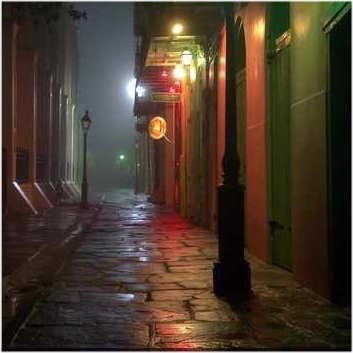
Look now to your left, up along the side of the Church. You have discovered PIRATES ALLEY!
Pirate's Alley is the subject of much legend and lore, some true, and much false.
Pirates Alley, about 600 ft long, and 16 ft wide, is not even shown on many of the French Quarter maps.
Wisely so, for many tourists have walked down its foggy length at night never again to be seen.
If it is so dangerous at night, why do tourists dare this avenue?
The sight of the alley at night is unforgettable.
Every surface is covered with moisture giving a shine and a reflection of the dim lights ahead along your path.
On your left, St. Anthony’s Garden, on your right, the old Fleur di Paris hat shop faces Royal St. with its beautiful window display that brings to mind a more elegant time.
But further along, you discover that a plaque on the wall of one of the Creole houses identifies this as the residence of the great William Faulkner, indeed, the very house where he wrote his first novel "Soldiers Pay".
And should the Soyoko find your scent pleasing, you may find "Unwary Tourist Pay."
Or you may find salvation in the form of the legendary undead Texas Ranger, Samuel McCord, the man with the blood of Death in his veins. Like Jean Lafite, McCord is a legend in the French Quarter
Likewise, the Lafitte brothers were no strangers to Pirates Alley.
They came to New Orleans about 1803 the year of the Louisiana Purchase, at 24 and 26 years old. Soon they went about with the Creole gentlemen of town and were seen in the streets and coffee houses.
Jean Lafitte spoke several languages and was educated. A familiar sight on these streets, people would regard him with curiosity, and whisper the word PIRATE! In reality, Lafitte considered himself a Privateer.
Of course, smuggling had been going on in the city for 50 years before Lafitte,
and it eventually became the main business, but soon, Lafitte and his band of Baratarian Pirates controlled black market commerce and all transactions went through the brothers.
Goods were sold openly in Pirates Alley and eventually it became so congested that the "vendors" were allowed to display their goods inside the garden behind the iron fence.
The locals would walk along outside and money and goods were passed through the fence, giving rise to the expression "Fencing stolen goods"!
I imagine that the brothers made regular charitable "donations" to the church for this convenience. No proof, but one cannot help but speculate.
And should you walk this alley at night, keep your eyes over your shoulders. Sometimes Alice the ghoul grows hungry. She, too, looks for donations ... of human flesh. ***
Sleep swept me along in currents of rich, quiet darkness as I drifted along ink seas under starless skies.
A thin, reedy voice spoke to my right. Gypsy yowled her "Not another friggin' ghost" yowl.
"All literature begins with geography."
I pried lead-heavy eyelids reluctantly open. Gypsy shoved her tiny head under my pillow, grumbling low. Robert Frost smiled at her from his ghost chair by my bed.
He gazed off into the darkness and murmured one of the last lines he ever wrote while alive :
"Unless I'm wrong I but obey The urge of a song I'm—bound—away!
And I may return If dissatisfied With what I learn From having died."
He turned his eyes back to me. "As it turned out, I was quite satisfied with what I learned. But Elinor has chased me out of our celestial farm tonight."
He rubbed his chin ruefully. "She says I always get insufferable on this day."
Gypsy pulled her head out from under the pillow and yowled. Robert Frost shook his head and answered my cat.
"Upon this day in 1963 I learned that my "In the Clearing" collection had won the Bollingen Prize for best book of American verse, 1962. It oddly pleased me to no end for some reason."
I tried to blink some clarity to the fog of my awakening mind. "Ah, Mr. Frost ...."
"Rob, please."
"Uh, Rob, do you really think all literature begins with geography?"
He laughed. "Starting with absolute pronouncements is an old teaching trick, Roland. You were a teacher as was I. You know that. It is human nature to rail against them, to kick holes in them, thus thinking through your own beliefs in the meantime."
He pursed his lips like a troubled librarian for a moment. "But geography certainly shaped my own poetry. You could call these places "Frost Country":
San Francisco, Lawrence, Derry, England, Franconia, Shaftsbury, Ripton and Bennington. These are the literary time capsules of my beliefs and will enrich your enjoyment of my poetry."
Gypsy angrily muttered under her feline breath, and Robert Frost chuckled, "No that is not the reason I disturbed your sleep, cat."
He patted his knees. "I wanted to tell you, Roland, to persevere. You, and all your blog friends, have more talent than you believe, and this new year will bring fresh harvests."
He rose slowly, smiling ruefully. "By working faithfully eight hours a day you may eventually get to be boss and work twelve hours a day."
He started to fade like a dream upon awakening. "No great wisdom from beyond I'm afraid. In three words I can sum up everything I've learned about life: it goes on."
He tapped my shoulder with all-but-invisible hand. "Forgive me my nonsense, as I also forgive the nonsense of those that think they talk sense."
The last thing I saw was his faint smile. "Now, back home to Elinor. Home is the place where, when you have to go there, they have to take you in."
And he was gone.
So? Do you have any tricks you use when you want to make your readers think? And do you think Rob was right? Does all literature begin with geography? Do the important places in your life affect how and what you write? ***
detailing the adventures of the orphan reputed to be the clone grown from the tissue sample taken from the Spear of Destiny.
Helped by the 14 year old fae assassin, Fallen,
the clone, Blake Adamson, has just escaped his captors, though mauled by the claws of Fallen in the doing of it :
Fallen crabbed slowly back away from me on her knees, still shaking her head in horror and dismay.
"N-No. No! Oh, Blake, I told you I-I'd be a hard friend, but not like this. Not like this!"
I shrugged, trying to hide how much it hurt, and forced out of my weak throat, "N-Now, show me a rose that doesn't have its share of thorns."
"I'm no rose," whimpered Fallen.
"Well, to me, you're as much a rose as the black roses whose perfume you have in your hair."
Fallen shook her head and, with so much self-hate in her voice it scared me, whispered in a hiss, "I'm no rose."
"Not a tame one, that's for sure," I sadly smiled. "But don't you know, Fallen? The wild roses have the sweetest smell."
Her long faerie face almost all eyes, she said softly, "Your lips just twitched, there, Mr. I-Don't-Lie."
I looked at her with so many warring emotions going at it inside me. Did I dare tell her the truth? Did I? I saw the lonely, self-hating hurt in those wet green eyes and knew I didn't have a choice.
"It's ... It's not just when I lie that they do that, you know."
"Oh, no? Then, when else, boy scout?"
Oh, man, did I have the nerve to say it? "Ah, well, ... they've been known to do it when ... when -"
"When what?," murmured Fallen, edging closer, her green eyes seeming to swallow my whole world.
"When, ah, I'm ... next ... to a pretty girl."
There, I had said it, and I could feel my cheeks blushing. No. Oh, no. Fallen looked miserable. Man, couldn't I do anything right? Not anything?
One single tear rolled down her cheek. "B-But that's just it. I'm not pretty. I'm not! I'm not even a girl. You heard Tartan. I'm a frea-"
Her next word I knew would break my heart so I didn't let her finish.
I reached out for her, taking both of her hands in mine. I put them next to my chest, hoping she wouldn't notice the blood on both our fingers. I hiked up my left shoulder a bit and smiled sad back at her.
"-a wild, beautiful rose w-who I'm proud to call 'friend'," I said soft, and without even realizing what I was doing until I had gone and done it, lightly kissing her fingers, claws and all.
I stiffened. Oh, man, what had I done? Was I crazy, or what? I had kissed Fallen. Sure, only on the fingers, but -- oh, no.
Look at what I had done. Big tears were welling up in her jade eyes. She just looked at me for what seemed a frozen eternity in time. I started cussing myself up a storm. What a moron. Why did I always screw up? Why?
And then, so fast it was a blur, she bent and kissed me soft on the cheek. She snapped back, looking as shocked as I felt. She cocked her head timid at me.
My lips not wanting to work right, I knew better than to try and say anything, so I just smiled shy back. I could feel my blush burning like a hot neon sign.
"Oh, no!," I cried aloud, dropping Fallen's hands.
"What's wrong?," she yelped, springing to her feet and spinning in a clawed crouch.
"Mr. Myers and Mr. Heke. They're still trapped in the Eldritch Industries Building."
Fallen slowly turned around, her face so sad and bittersweet.
"Blake, Blake. You big, dumb boy scout. You worry about everyone but yourself."
Fallen stamped her right foot angrily. "Blake Adamson, when are you going to start worrying about you?"
John Steinbeck wrote of photojournalist Robert Capa
in a quote that launches the well-written, exhaustively researched biography, BLOOD AND CHAMPAGNE :
"Like the pen, the camera is as good as the man who uses it. It can be the extension of his mind and heart."
Blood and Champagne.
The term could be used on the yin yang of that most bothersome of aspects to our writing : pacing.
A good friend emailed me on a bit of a bother she was having with pacing on her WIP. It occurred to me that if she, as good a writer as she is, was having troubles with pacing, some of you might be having similar problems with it as well.
Both THE LEGEND OF VICTOR STANDISH and its sequel, VICTOR'S NOT JUST MY NAME, have a lot of action in them. But like with pepper, action must be used wisely. But too much introspection or description is dangerously bland.
Pacing is all-important.
Think of the best jokes : there is always a prep time that leads to the punch line. Without it, the punch is muted.
Where are your transitions in your novel? How does your MC get from here to there? Reflection along the road, whether it be a physical one or a metaphysical one, is always a good way to pace -- and sow seeds for appreciation of the action to come.
The best monsters, the scariest moments in horror films are always the glimpses not the full shots.
In your novel, you show a terrorist place a suitcase under a table. You give a close-up of the timer : 60 seconds.
Two lovers sit at the table the terrorist just left. They talk about things important for the reader to know to understand the action of what is to come. But despite the flow of backstory, the reader stays keyed-up because between every paragraph you put one line :
40 seconds. 30 seconds. 15 seconds. 7 seconds.
No action. Only suspense. Then, BOOM!
It is a matter of instinct. It is, after all, your novel. Tell it your way. If your instincts bother you about a scene, listen to them. Ask if the pacing is off in some way. Too much build up? Not enough?
Each chapter is a three act play all its own. But with a difference -- each must end with a hook to link to the chapter following.
Each chapter must breathe.
No one inhales all the time. You have to exhale. So does the reader -- give her and him a chance to reflect.
Reading without reflecting is like eating without digesting. Give your characters a moment to savor their victories or cringe from their defeats. Blows leave bruises. Show them. Let the readers see your characters limp from life's impacts.
Actions have consequences -- perhaps your instincts are telling you to paint the consequences more fully with an extra paragraph or scene or two.
If you want to slow the pace, write longer sentences -- when you want the reader to consciously think about what you're showing him.
This is true for paragraphs -- it will slow down the speed of the reader. But don't over-do this. Long, blockly paragraphs tire the reader.
Pace is the tempo at which a scene moves. You are the conductor of your own orchestra, playing your own composition.
You know the overall story you want to tell. Slow down to build tension and hit the reader with short, active sentences and paragraphs to tug the reader along for a wild ride.
Use shorter sentences when you want the reader to react, not to think -- as if he's taking part in the whirlwind action.
Then, too, there are hard words and soft words, both in sound and meaning.
You can choose either or both. Hard words are those that contain hard consonants or create small explosions of breath when pronounced: b-d-t-v- x-z, for example.
Soft letters let the breath escape slowly or create the sound in your throat or mouth: j-l-m-r-,s to name a few.
Though we don't read aloud usually, we still "hear" the words in our heads. So use those hard and soft words artfully to subconsciously build the mood you want.
Some words themselves create feeling:
He drew her head back / He yanked her head back.
Both sentences paint different pictures and create different feelings about the action.
Having a character flex his hands hints at strength more than his stretching his hands would.
The overall pace of a novel needs to escalate as the story moves forward in order to keep the reader interested.
It has peaks and valleys along the way. Each peak must be higher than the ones before it, and each valley not as deep.
This gives the reader less time to catch his breath and little or no inclination to put the book down.
A good way to learn more about pace is by paying special attention to how published authors control pace in the novels you enjoy.
When a scene makes you bite your fingernails or clutch the edge of the chair, insert a slip of paper to mark the place so you can study the scene after you finish the book.
Analyze the scene this time, notice things the writer did that caught you up in what was happening as the pace sped up. How did the author stir your emotion or evoke a physical response?
Mastery of the fine art of pace comes with experience. Start getting it now with these few tricks and add and refine your pacing skills as you grow in your writing career.
I hope these thoughts helped you in some small way.
*) A word about my ending to GHOST OF A CHANCE and about my novella in general :
My ending is an analogy of sorts :
We authors do go throuh Hell, bringing our Main Character through the tribulations that end in a satisfying conclusion.
And also, we authors face the temptation of staying too long at the end, reluctant to leave those characters we have come to know and perhaps to care for deeply.
Best to leave the readers with laughter, a lingering melody, and a glimpse of love rewarded ... but only a glimpse, the readers' minds will fill in the details much better than we ever could.
See? My ending, in fact of all of GHOST OF A CHANCE, was a lesson on how to write a little better. Some lessons in how to do it. Sometimes in how NOT to do it. I wrote some of those chapters dead exhauted. Hopefully, knowing that, re-reading will be even more fun for those of you who do it.
Happy New Year, Roland *** The love that shaped Ernest Hemingway's life for both good and ill :
"Toya, you know perfectly well that Captain Sam sent those clothes to Roland to say 'Thanks' for helping him in Hell."
Her coffee cream face became a living sneer. "Victor ...."
She tossed him the package. "Stick it!"
He flashed a gypsy smile. "Sure thing. Bend over."
Marlene chuckled, "I like you."
Victor winked at her, handing her the package. "This contains an evening gown for you, too, ma'am."
She mussed his hair, smiling gently at his blush. "Marlene, Victor. And if you're a very good boy, I will let you escort me to my quarters here in Meilori's."
Victor laughed, "And if I'm a naughty boy?"
"Why then, I'll let you peek," Marlene laughed back .
Mark Twain gruffed to me. "I better get Gypsy back to your apartment and apologize to your blog friends."
"Apologize?," I frowned.
Mark rubbed the back of his neck. "Well ... I wrote them you'd died."
"What?"
Mark sputtered, "You looked damn dead when I left, son."
Gypsy took a swipe at him through the carrier. He lifted it up and groused, "You keep that up, gal, and I might have to change my mind about how I feel about felines."
Gypsy yowled at him. Mark Twain chuckled, walking into the growing mists of Meilori's.
I watched them grow smaller and smaller in the fog while their bickering and yowling grew louder and friendlier. I smiled. I was seeing the start of a strange friendship.
I turned around. Marlene was walking arm in arm with Victor. I followed, shaking my head as she tried (and succeeded) in getting him to blush more and more.
Which explains how that photograph of Marlene above came to be taken. She was even more stunning than usual, standing by the piano Ellis Marsalis played. His son Wynton blew his trumpet as Frank Sinatra sang, "Stella By Starlight."
Standing in my new clothes, I smiled as I heard Frank substitute 'Marlene' for 'Stella' in the lyrics. Ava Gardner, sitting at a table close by, winked at her old love for his compliment to her friend.
Glowing slightly from his sojurn in the inferno, Sam McCord strolled up to me, "Thank you is too small a word for you going to Hell for me, son."
He looked like he was biting into a squirming snail, "Which makes me having to ask you to leave a hard thing."
Marlene stiffened at his words. She stormed up to us, proving her hearing was even more awesome than her beauty, but not her temper. "You speak 'thanks' and yet order him out?"
Sam held up a gloved hand. "Marlene, it's for his own good. He's become a legend of sorts here in the Shadowlands. The longer he stays, the more chance someone is going to try and add his scalp to their lodge pole."
Marlene's chin rose defiantly. "An hour. He will have an hour with me here. I will accept nothing less."
Sam shook his head wearily. "I know better than to argue with you when you're in this mood."
Marlene's eyes sparkled dangerously in the dim light. "You are wise."
She turned lazily and floated to Frank, whispering in his ear. Then, she bent by Ellis and Wynton, talking low to them. Frank, smiling wide, walked and sat down by his love, Ava. Ellis and Wynton started playing "The Very Thought of You."
She walked back to us and pointed a long forefinger at Sam. "You will guard Roland's back while we ... dance."
She dragged me to the dance floor, and I protested. "Marlene, I haven't danced in a long time."
She playfully nipped at my earlobe. "With me in your arms, Liebling, you will float."
She wasn't being poetic. We did float. She felt light yet firm and amazingly soft in my arms. We danced close for long moments, then Marlene began to sing low in my ear.
"The mere idea of you, the longing here for you, You'll never know how slow the moments go until I'm near to you."
So with Sam pretending not to see, and Ava winking at Frank, . ... Marlene led me off the dance floor, up the stairs, and into her private quarters in Meilori's ...
Humans aren't the only ones who suffer from sagging middles.
Novels do, too.
It's accompanied by that leaden feeling that weighs you down with the mocking question :
"What were you thinking of when you thought you could write a book?"
When you hear that voice, I want you to answer, "DUH!"
D ..... DISASTERS
U ..... UNDERLYING
H ..... HEROES
DISASTERS :
I.) Disaster. When your novel's middle sags, you certainly know that word. It's what you feel you are writing!
II.) Escalating Disasters ...
A.) are what make up the backbone of the best novels.
B.) without them, you're just writing a news snippet for CNN.
C.) Each disaster must lead logically from the last one to make a coherent whole.
D.) But to interest an agent, then the publisher, and finally the reader ... you must have a destination in mind for your hero from the very beginning.
III.) If your novel's middle is sagging then ...
A.) Like with humans, the discipline of exercise is missing.
B.) The disciplined exercise of steadily working towards a pre-conceived ending, step by logical step.
C.) Without that compass to guide you, your novel will meander all over the place, subject to the whims of your imagination.
UNDERLYING :
I.) The trouble with a novel that its very structure invites sagging in the middle.
II.) Your novel's middle will more than likely take up fully half of your pages.
A.) After that many pages, things start to look alike.
B.) The fix : underlying that middle with a tremendous disaster, rocking your hero and his world to its foundations.
C.) Shaking things up like that will awaken your readers from the sameness doze they may have fallen into :
Think Obi wan Kenobi sacrificing himself so that Luke may escape. To all appearances, Darth Vader looks unbeatable.
D.) This enormous disaster shores up your novel's middle, firming it up and preventing sagging.
HEROES :
I.) A memorable character that leaps off the page and into your reader's imagination is the keystone to the success of your novel.
A.) Think Hannibal Lector.
What? Hannibal a hero? Of sorts. He chose his victims quite carefully. Don't agree? Think Dexter. Same principle. We pull for Dexter, for he has chosen an acceptable outlet for his murderous impulses.
B.) UNDERLYING comes into play again with your hero :
Your hero was not born yesterday. He/she has a past. It will determine his or her actions. You had better know your hero's backstory.
C.) In fact, your hero's backstory may very well provide the world-shaking disasters that braces your novel's middle.
D.) You see how DISASTER - UNDERLYING - HEROES all interweave with one another? It is a support device that wraps around your novel's middle, keeping it firm.
E.) A fully developed hero with a past, flaws, hopes, failures will make him seem real, sucking your reader into identifying with him, rooting for him, and thrilling with him when he succeeds.
F.) Without a backstory, your reader will not understand your hero -- and more than likely, neither will you. And that slippery slope ends with a sagging middle and confused muddle of an ending.
G.) Backstory is an iceberg ;
1.) The part that is important to you as a writer is the 9/10 of it that the reader cannot see.
2.) The part you must tell your reader is the tiny 1/10 above the water line.
3.) Sensory and data overload is one of the hallmarks of a sagging middle.
H.) What determines the backstory you reveal to your reader?
1.) Core truths.
2.) They determine your hero's motivations, acting as a rudder in the flow of events in your novel.
3.) They often conflict.
You know why Miss America wants "World Peace?" She wants to impress those fuddy-duddy judges and win the war of the beauty pageant! Stated values often clash with the real ones, motivating your hero.
II.) A dynamic hero, like say Robert Downey Jr.'s portrayal of Tony Stark, shored up those times when he he wasn't in that armor -- those moments could very well have sagged -- but because of his impish, rogue attitude, those moments were some of the best of the film, IRON MAN.
*) I hope you've found something of value in this little post. Happy New Year, Roland! ***
Dreamer. Writer. Believer in the worth of each soul I meet.
It is not so bad a thing to have been born with the gift of laughter and the knowledge that the world is mad.
Book 4: Victor Standish risks all reality to bring back from the dead those he loves.
WOLF HOWL HAS HIS OWN BLOG!
VISIT IF YOU DARE
THE LAST SHAMAN AUDIO BOOK!
Mankind's time is nearly up. Can the last Lakota shaman save the soul of the assassin he loves before the end?
McCorkle Creations!
Let Heather McCorkle design covers and promo materials for you. You will be amazed.
ONLY $4.86!
Sometimes it is death, not life, that brings us love
A GHOSTLY WRITING MANUAL
Twain, Hemingway, Lovecraft & More!
An Age Is Ending & Ancient Evil Returning
Like PENNY DREADFUL? This is for you.
A SUPERNATURAL LONGMIRE
In Egypt, the dead never rest easy
NO ONE HEARS THE SCREAMS IN SILENT FILMS
An isolated Hollywood film crew is hunted by Nightmare
A SAMPLER OF MY HEROES
Mysteries Explained, Secrets Exposed
The Origin of Toomey Starks!
Hellhounds were never this much fun! Only $4!
VOODOO & LOVE IN THE FRENCH QUARTER
Now available in PRINT!
FRENCH QUARTER NOCTURNE AUDIO BOOK!
The supernatural predators come out after Katrina. Can two undead legends stop them?
AFTER KATRINA, THERE IS NONE BUT TWO TO STOP THE UNDEAD
ONLY $1.99 WHEN YOU BUY THE KINDLE BOOK!
LISTEN to GHOST OF A CHANCE
Can an author be drawn into his own fictional world and killed by his own characters?
HIBBS HAS FOUND HIS VOICE!
A tale of enchantment
Souls At The Crossroads
Where do you need to be?
THE DEADLIEST ENEMY IS WITHIN
What if Stephen King wrote of the life of a blood courier?
Listen to this haunting tale of horror and love
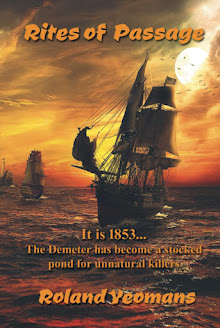
It is 1853. An undead Texas Ranger is on board a cursed ship in search of a murderer who is wearing the face of her last victim as a mask.
Listen to the LAST FAE
When the world is mad, there is little else to do but show them what true insanity is!
Can a man marry both the moon and the sun?
In the eclipse of myth, he can
What Defense is an innocent soul against the Powers of Darkness?
Let Hibbs, the cub with no clue, show you
Before Indiana Jones or Allan Quartermain
There was Sam McCord and his doomed love for Meilori Shinseen
Alice and Victor in 1834 New Orleans
Do a review and have a 1 in 13 chance to win a Johnny Depp autograph!
Buy_FRENCH QUARTER NOCTURNE
Hurricane Katrina has cast New Orleans into darkness. Predators, living and undead, close in on the helpless survivors. Can Samuel McCord and a vampire priest keep the French Quarter from being drowned in blood?
Buy_LET THE WIND BLOW THROUGH YOU
Enter the dangerous world of a Native American Noir thriller where forbidden love clashes with the politics of crime
You will never see the end coming
In his beginning is his end
My 1st SERIAL TRILOGY continues
There are none so lost as those who refuse to see
The 1st SERIAL TRILOGY!
In the dark, we are all orphans
In Memoriam - Maukie my cyber friend
RITES OF PASSAGE link
The earliest Samuel McCord adventure: Dare to board a fantasy Titanic as it sails into the Bermuda Triangle
VICTOR'S HERE!
BOOK 1: No one talks openly of the misty figures seen walking along New Orleans' iron-laced terraces, casting no shadow. Of the shapes seen rising from sewer grates. And no one willingly visits the crypt of Marie Laveau at midnight. Into this strange world arrives the street orphan, Victor Standish, from Charon's Greyhound. Charon has to keep up with the times ... the End Times. And the teen destined to be called the "Ulysses of the French Quarter" has come just in time for Hurricane Katrina, the End of All Things ... and the deadly love of the Victorian ghoul, Alice Wentworth.
VICTOR AND ALICE ARE BACK!
BOOK 2: Victor's a street kid. Alice is a Victorian ghoul Their love breaks the chain of reason. Their new adventures bring the French Quarter back from the brink of nightmare.
THE RIVAL
BOOK 3: Victor & Alice are in the French Quarter of 1834. Voodoo. Demigods. Revenants. And the hilarious Menage a Trois of Death! Oh, and someone we love dies at the end.
END OF DAYS is here!
St. Marrok's. The most eerie high school in which you will ever die. Its curriculum? The End of Days. Alice Wentworth plans to get an A+.
ADRIFT IN THE TIME STREAM link
SEQUEL to RITES OF PASSAGE: Come aboard the doomed DEMETER with undead Texas Ranger, Sam McCord, and sail with her into the depths of madness in ADRIFT IN THE TIME STREAM.
Buy_CREOLE KNIGHTS
SEQUEL to FRENCH QUARTER NOCTURNE: The dead rise. Elder Beings strain to enter our world through Katrina devastated New Orleans. And the Angel of Death is kidnapped to clear their way. Can Sam McCord stem the tide of madness in time?
Buy_THE LAST FAE
Once there was an age undreamed where legends walked this earth … and nightmares, too. Terrible were the battles, tragic the outcome of the wars. Until finally there were only two survivors : the nightmare and one bruised legend. These are the legend’s stories, each one a different facet of the same priceless gem – a jewel that has come to believe herself worthless. So come. Listen to her. Listen to THE LAST FAE.
GHOST OF A CHANCE
What if what you wrote became real?
BURNT OFFERINGS
When dreams are sacrificed, it is the soul that burns.
CHECK OUT THE FUN!
Explore if you dare
Buy_THE LAST SHAMAN
Journey with the last Lakota shaman, Wolf Howl. The white govenments call him Drew August. Those who hunt him call him Death. The last day of Man has dawned. Watch as Wolf Howl turns to meet his human hunters. Shadow, the love of his life, returns to aid his hunters. Then, Mankind's death descends. Can he save Shadow before the world's time runs out?
BRING ME THE HEAD OF McCORD!
Only 99 cents. C'mon. Take a chance.
GHOST WRITERS IN THE SKY
LEARN TO WRITE BETTER AND LAUGH ALONG THE WAY
LAST EXIT TO BABYLON
At the dawn of the End of All Things, the Last Fae finds there is no hope ... but love.
IT'S HERE TO BUY!!
The trilogy concludes. Not even the eclipse of myth is forever. But love is. And eclipses return. Listen. The voice of Blake, son of Man, is calling across the night skies.
Buy THE PATH BACK TO DAWN
Only in the eclipse of myth can a young man find himself with both the Moon and the Sun as his brides. Can he survive what follows?
Buy_LOVE LIKE DEATH
From the pages of THE LAST FAE springs this paranormal romance/thriller. Fallen, the last fae, discovers the name of the young teenager to whom she lost her heart : Blake Adamson.But she also discovers what happens when you believe your fears over your love : heartache and loss. And so Blake Adamson finds himself torn between two loves : one fae, the other an alien drinker of souls. Their love is deadly, but love, like death, will have its way.
THE BEAR WITH 2 SHAD0WS link
Based on the stories my Lakota mother told me as a child when I was deathly ill in a freezing Detroit basement apartment. Think a Native American LORD OF THE RINGS.
FROM THE GREAT BEYOND HOP!
You dare not miss it!!
ZOMBIE PREPAREDNESS!
LISTEN TO THE CDC
Thanks, Alex!
THE WORLDS OF ROLAND YEOMANS
Donna Hole astonishes with her insights on my linked worlds
FANTASTIC REVIEW OF THE LEGEND OF VICTOR STANDISH
Michael Di Gesu does a masterful review. I am honored by his friendship
LIFE LESSONS taught me by GYPSY
Dedicated to GYPSY
PAPYRUS PRODUCTIONS
Have Wendy make your book into a trailer that wows the reader!
HELP THE HURTING
100% of the profits for ALL my books this FEBRUARY are going to THE SALVATION ARMY. My Valentine's gift to the hurting.
Buy_BLOOD WILL TELL
One lone telepath finds himself a helpless spectator as the race of Man is subjugated into mindless drones by the very blood within their bodies.When the war is over, and he finds himself totally alone ... How can he go on and why?
CALL ME TOMBS
The last Lakota Heyoka faces voodoo and ultimate evil in the Carpathian Mountains of Transylvania with his Hellhound, Puppy
CATCH FIRE!
BLOG TOUR FOR ALEX J, CAVANAUGH'S NEWEST NOVEL
SIV'S BLOGFEST!
The Norse Gods Are Watching You!
NERDY IS THE NEW SEXY!
BECOME A JEDI KNIGHT FOR TEENS
THE SECRET OF SPRUCE KNOLL
Help save the endangered species of Earth by buying THE SECRET OF SPRUCE KNOLL!
AMAZON KEEPS SELLING OUT!
Written by the author who could very well turn out to be the new William Faulkner, Elliot Grace
FABULOSITY GALORE bookstore
Visit an online bookstore and help a blogging friend!!

 Posts
Posts