FREE KINDLE FOR PC

FREE KINDLE FOR PC
So you can read my books

Thursday, April 4, 2013

W is for WILDE ... OSCAR WILDE vs. GORE VIDAL

*
I was writing in the dim interior of the haunted jazz club, Meilori's.

I heard a mellow yet deep voice to my right. "Dear boy, don't tell me you're still persisting to write?"

I looked up.


Gore Vidal.

Or rather his ghost, looking rather dapper and nearly as young as me.

He sat down, leaned next to me, reading what I had just written on SLAYBELLES IN THE NIGHT, and shook his head.

"Roland, half of the American people have never read a newspaper. Half never voted for President."

I smiled. "Let's hope it's the same half."

He slapped my arm. "You're stealing from me!"

"Steal from the best Oscar Wilde always said."

He leaned and scanned my laptop screen again, nodding. "You have your own distinct sytle. Style is knowing who you are, what you want to say, and not giving a damn."

I made a face. "And it's gotten me so far."

Gore raised a long forefinger in admonition. "I’m not sentimental about anything. Life flows by, and you flow with it or you don’t. Move on or move out.”

I nodded and sighed, "It's just that sometimes I get depressed."

Gore smiled sadly. "As do I, my boy. As societies grow decadent, the language grows decadent, too.

Words are used to disguise, not to illuminate, action:

you liberate a city by destroying it. Words are to confuse, so that at election time people will solemnly vote against their own interests.”

He tapped my laptop screen. "But words like those of your friends and you give me hope. How marvelous good books are, crossing worlds and centuries, defeating ignorance and, finally, cruel time itself.”

I asked, "What would be your advice to my writing friends, sir?"

He smiled wickedly, “Write what you know will always be excellent advice for those who ought not to write at all. Write what you think, what you imagine, what you suspect!”

He winked at me. “You can't really succeed with a novel anyway; they're too big.

It's like city planning. You can't plan a perfect city because there's too much going on that you can't take into account.

You can, however, write a perfect sentence now and then. The trick is to write one after another.”

He looked off into the bronze mists of Meilori's. “The most interesting thing about writing is the way that it obliterates time.

Three hours seem like three minutes. Then there is the business of surprise.

I never know what is coming next. The phrase that sounds in the head changes when it appears on the page.

Then I start probing it with a pen, finding new meanings. Sometimes I burst out laughing at what is happening as I twist and turn sentences.

Strange business, all in all. One never gets to the end of it. That’s why I go on, I suppose. To see what the next sentences I write will be.”

A tall ghost sat down on the other side of me. Oscar Wilde. He laughed.

"Roland, as a young man in the South, you are in a splendid position to write great novels. Southerners make good novelists: they have so many stories because they have so much family.”

Gore's eyebrow rose. "I said that!"

Oscar smiled wide. "As I have been quoted: if you are going to steal, steal from the best. Go on. Admit it. I'm your hero, Gore."

Gore gave Oscar a look that would have curdled vinegar. " Don’t ever make the mistake with people like me, thinking we are looking for heroes. There aren’t any and if there were, they would be killed immediately. I’m never surprised by bad behaviour. I expect it."

Oscar pouted, "You think me nothing but a gossip."

Gore relented, "Everybody likes a bit of gossip to some point, as long as it’s gossip with some point to it. That’s why I like history. History is nothing but gossip about the past, with the hope that it might be true."

Oscar laughed deeply, "Oh, the gossip about me is definitely true ... if it is bad."

Gore looked sadly at my laptop screen again. "It is all a waste, you know."

"What, sir?"

"Your striving for quality, for uniqueness. In the case of the new writers, rather like priests who have forgotten the meaning of the prayers they chant,

we shall go on for quite a long time talking of books and writing books,

pretending all the while not to notice that the church is empty and the parishioners have gone elsewhere to attend other gods, perhaps in silence or with new words."

I said, "People still read, sir."

Gore nodded grimly, "The fad of the moment is what they read. Not to think, not to reflect, but to be aroused."

Oscar shook his head firmly. “The malady of civilized man is his knowledge of death.

The good artist, like the wise man, addresses himself to life and invests with his private vision the deeds and thoughts of men.

The creation of a work of art, like an act of love, is our one small yes at the center of a vast no.”

Gore grumbled, "You just stole my words again!"

Oscar nodded, "Because you seemed to have forgotten them. We writers exist to be the 300 Spartans in the tide of ignorance and hopelessness."

I raised an eyebrow. "I thought it was to be on the best seller list."

Oscar laughed, "That, too!"

***
What favorite author(s) of yours would you like to chat with at a haunted jazz club?  What would you ask him/her?  What do you think they would think of today's books and publishing industry?

*{As the restrictions on this photo collection expired in 1986, the Library of Congress believes this image is in the public domain.


 However, the Carl Van Vechten estate has asked that use of Van Vechten's photographs "preserve the integrity" of his work, i.e,

that photographs not be colorized or cropped, and that proper credit is given to the photographer. Such has been respectfully done.}


Wednesday, April 3, 2013

X is for X MARKS THE SPOT for a bad girl friend & X-RATED INSECURE WRITER'S SUPPORT POST!

 
For those of you emailing me that I have been
going over the requested limit. 
 
Here is Xena to my rescue!  :-)


To Those of You Who Are Looking for an Insecure Writer's Support Post, here it is:


DOES X-RATED SEX MEAN SALES FOR YOUR NOVEL?


Readers are snapping up E.L. James' Fifty Shades erotic trilogy faster than billionaire Christian Grey can handcuff his innocent young mistress Ana.
 
No surprise, then, that mainstream publishers are eager to pounce on the next hot new erotic romance.
 
Berkley has already scored with Bared to You, Sylvia Day's tale of erotic obsession, which climbed to No. 10 from No. 36 on USA TODAY's Best-Selling Books list.
 
Originally self-published, Bared was snapped up and repackaged with a Shades-like cover featuring silver and gold cufflinks.
 
"Everyone in publishing was trying to figure out what the Fifty Shades of Grey fans would read next," says Berkley Books publisher Leslie Gelbman.
 
"When we discovered Bared to You, we knew it had the potential to be the next erotic romance breakthrough."
 
The Berkley paperback edition of Bared had a first printing of half a million copies, and 100,000 e-books have been sold since Berkley assumed distribution.
 
Berkley will follow Bared to You's success with Because You Are Mine by Beth Kery, a serialized erotic romance e-book to be released over eight weeks.
 
Question:
If you were assured bestseller status in USA TODAY, would you write erotica that included the demeaning of women or men? 

Would you write a genre you hated if assured bestseller status?


Tuesday, April 2, 2013

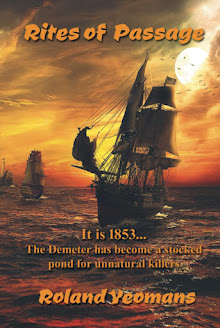
Y is for YEOMANS ...Let me introduce him to you.

{The photo on this cover is in the public domain in that it was published in the United States between 1923 and 1977 and without a copyright notice.}
 
"The secret?
It is every artist's secret ... passion.
That is all. It is an open secret and perfectly safe.
Like heroism, it is inimitable in cheap materials."
- Willa Cather
 
Roger Zelazny, ghost here:

The ghost of Hemingway is presently keeping Roland company on one of his blood runs.

Hemingway is reminded of his own days driving an ambulance in WWI when he accompanies Roland.

So it is left up to me to talk to you mortal writers.

Most of you are scoffing that the ghost of Roger Zelazny is currently typing his thoughts to you.


Impossible you say.

You, and the rest of mankind, are quite sure what is possible and what is impossible.

In the daylight.

When the night descends, the stride of your thoughts is not quite so confident.

Not so Roland.

He is much like an animal. I do not mean that as an insult.

He takes what comes at face value, not forcing it to fit into any preconceived notions Man teaches as Science.

He deals with what comes without protesting that it cannot be, only seeing what is and adapting.

Perhaps that is why we ghosts are drawn to him. In him is that quality that Stubbs expressed in MOBY DICK:

“I know not what all may be coming, but be it what it will, I’ll go to it laughing.”


Not that he is overly optimistic about the world around him.  Despite being part Lakota Sioux, he still reads the Bible by his bedside. He often quotes:
“They sleep not, except that they have done mischief;
And their sleep is taken away unless they cause
Some to fall.

For they eat the bread of wickedness
And drink the wine of violence.”


That is Proverbs 4:16-17 for those of you interested in such things.


In life I was not.

I thought the love of God was like the light burning from the stars:

cold and distant.

Now, that I am a ghost …

but no.

There are some secrets the dead may not share with the living.

But the secrets on how to write well … they I can share with you.

Oh, you are wondering who I am.

Don’t be embarrassed. In life I wondered the same thing.

As I wrote earlier: I am Roger Zelazny.

I made somewhat of a splash in Science Fiction in the sixties, endured and evolved in the seventies and eighties.
I went the way of all flesh mid-way through the nineties in Santa Fe, New Mexico.

And Roland mourned me as a distant older brother
gone over the crest of the hill before him,
leaving him cold and alone.

Oh, and I inspired him to take up the pen and follow my steps into weaving tales in the genre I call Science Fantasy.

That I sparked the idea in him to be a writer drew me to him.

It was his gentle, quiet, amused nature that has made me stay. He looks on all the awkwardness of life with a sly smile that says, “You expected water to run uphill?”
 
But now I have an important question for you reading:

What makes one tale live, vibrant and riveting, and another merely flat, lifeless words on paper?

Not that any of us have a sure idea,
although Hemingway would glare at me for writing that.
 But we had a close enough glimpse of the answer
to make a living at what we loved to do:

Write.

What is the answer?

A joyous cry: “Come see what I found!”

If you can bring anew the childlike sense of wonder and awe
to your readers that the poisons of living
have drained from them,
you will have a loyal following that will not quit.

What words will do that?

Certainly not the same sing-song repeat and rinse
of someone else’s bestseller.

The words must tilt the reader’s expectations on its ear.
 Did you notice I said reader?

Not readers.

You are talking to only one
at the campfire of their imagination and curiosity.
If you think of your audience as readers,
you will talk AT them not TO them.

The author/reader relationship is intimate: friend to friend. “Look at this, man!”

One friend sharing with another something fantastic and wondrous:

The meaning of life in the skating sparks of the sun along the uneven facets of a piece of rock candy …

or striking fire down the razored spirals of a unicorn’s tusk.

If you are drawn to write, you do not need to be told the basics. You already have absorbed them from the masters:

Stirring plots, memorable characters, and absorbing ideas.

You must tap the humanity of the situations, of the people struggling against the tide of events.

Remember this is the Microwave Culture.

Your prose must be lean and spare, yet sing with the poetry of mystery and suspense. How do you do that?

Mind your surroundings.

Nothing is ever wasted to a real writer. Circumstances suggest. Events coalesce. The story will begin to flow like a shadow along the floor of your unconscious.

Once you have seen their shapes, the stories will exist as ghosts for you until you have pinned them to the paper. Perhaps that is why there are so many ghosts of writers in the Shadowlands.

We made our living from ghosts,
so reciprocity demands its due.

Sometimes you will have to post a Help Wanted Ad
in your unconscious to apply for positions in the story
and events that have called out to you.

Do not worry.
Within the hour, your unconscious mind will have them lining up for you to consider.

Read your work aloud.

Hear the clumsy prose misstep that jars your ears?
A sentence is too long? Make them two.
A word unneeded? Remove it.
Sand your prose as a sculptor would his carving.

Give your characters life by giving them a new take on what it means to be human, to be fully alive.
Most people you pass on the streets are sleepwalking
from long years of debt and unfulfilled passion.

Give them hope that there is more out there,
that each corner could reveal the start of an adventure
that might shorten their lives but awaken their souls.

Do that and you will become more than a writer. You will become an author.

Want to read more on how to be an author? Buy GHOST WRITERS IN THE SKY:

http://www.amazon.com/GHOST-WRITERS-THE-SKY-ebook/dp/B006Z1MAP6

I have several chapters in it as does the ghost of Hemingway, Twain, Faulkner, even Bruce Lee and Groucho Marx!


***

Monday, April 1, 2013

Z is for ZOMBIES ARE US!

 
Ghost of Mark Twain here.

And no, you ain't seeing things backwards, children. 

Roland lost a bet with me at Meilori's, so I get to start the A-Z CHALLENGE ball rolling.


Why, wouldn't life be infinitely happier if we could only be born at the age of eighty and gradually approach eighteen?

So I thought I'd start at Z and leave it to Roland and his other ghostly friends to work to A.

And if that riles you, I remind you who the beloved literary genius happens to be t'wixt the two of us!  :-)

Which brings me to ... Zombies!

Whoever thought those critters with terrible table manners would be as popular as they are in this cross-eyed age?  Certainly not this pilgrim.

Now, I am sure part of their popularity in this loving, compassionate society is the fact of seeing violence gleefully performed on seemingly deserving subjects:

Zombies can be killed in no end of creative ways, and since they don’t feel pain and are already dead, there’s  no real need to feel guilty about it ...

and life for most folks these moral-dented days it seems is running from the very concept of guilt, don't you know?

But I further propose, children, that your fascination with zombies represents a subpressed understanding that something is wrong—

morally wrong—with our culture.

Why, zombies represent the appetite divorced from nigh everything else. They are incapable of judgment, self-awareness, or even self-preservation.

Though they still move and act, they are not really alive.

They hunger and are never filled ... much like your average Congressman!

And why they ain't just hungry for anything—they specifically want to eat the living, and even more specifically the brain, seat of rationality and self control.

I submit that this rise in popularity of zombies reflects a rise in anxiety over the elevation of appetite in modern life,

a popular recognition that appetite has gotten out of control, and that unchecked, unreflective, and immoderate appetite is a form of the worse death imaginable.

What do you readers think?

Sunday, March 31, 2013

THE GHOST OF EASTER PRESENT

{Public Domain painting by Antonio da Correggio}
(August 1489 – March 5, 1534)
 
 
Today is Easter.
Does anyone care?  Is faith still relevant in the modern world?
 
In the UK, 44% of those polled recently said they had no religious affiliation.

Another 14% of Britons asked three years ago said they did not know who Christ was.
One-fifth of U.S. adults say they are not part of a traditional religious denomination.
 
In this postmodern world nothing seems certain any more.

To hope for a better future seems unrealistic, maybe even irresponsible.

Is hope still possible and realistic in such a context? Is the Easter joy and hope still credible?

 In a world where violence abounds and people fight each other, one wonders whether the message and significance of Easter is still relevant.

Some say that Christian hope – not to be confused with optimism – is not only possible, but is what is required and called for from Christians.
 
Perhaps hope is not based on visible signs, but rather on the firm trust and conviction that God is part of human history and is bringing about a new reality, commonly called the Kingdom of God.
 
Can rational people believe this is happening here and now, even in the midst of discouraging signs?

Perhaps Easter is a time to remind us of the message of Jesus and the example of love, forgiveness, reconciliation and peace.

It provides us an occasion when Christians celebrate the message of hope for everyone.

 To remember in our daily lives to love one another and be peacemakers.

That command could well be seen as the embodiment of Christianity, for love is the fulfilment of God's law.


In a strange way, Christian hope is hope against hope. Does it make sense for Christians to hope for a better and transformed future?
 
Is the resurrection of Jesus a paradox or “mystery”?

Is it an event that contains meaning far more than the human mind can imagine or comprehend?

Is the empty tomb an indicator of the radical reality of the resurrection?

Does it stand as a historical witness to the fact of the resurrection and also ground the mystery to a particular event?

 Jesus, the one who was killed, no longer lies dead in the tomb?

Perhaps the only real proof to the resurrection is the life of believers –

But without the fact of the empty tomb it would be easy to reduce the resurrection to only a spiritual or psychological event.

Some would say that the resurrection is the source of Christian hope because believers no longer live in a world closed to the full extent of God’s grace and mercy.

They live under open heavens of divine communication. The resurrection is not a dim and distant future reality which will happen on “the last day”;

it is a reality already in the present.

What do you think? Is there any meaning to Easter anymore? Does it make any difference in today’s harsh world? 

Saturday, March 30, 2013

HOW TO WRITE THEIR BEST READ OF THE YEAR


"At the age of fourteen

I discovered writing as an escape from a world of reality


in which I felt acutely uncomfortable."

- TENNESSEE WILLIAMS, Forward to Sweet Bird of Youth


*) Tennessee gives us the first clue:

Readers usually first discover the world of books for the same reason Tennessee found the realm of creating his own worlds:

Something was lacking in their daily lives.

Like the hunt for the mythical will-o-wisp, the hunt for the fulfillment of that lack drives them even today to read.

In childhood, we often feel different, feel outside the group, feel weak, and feel unloved.

Those same ghosts haunt many into their adult lives.

Give readers a protagonist that they can identify with,

whose goals and hurts echo their own,

and dangle the fulfillment of those aims in front of them being threatened

 -- well, you've certainly gotten their attention.


Which brings us to the real number one.


1.) Learn the lesson of Madonna:


Before you can get them to read your book, you have to get the reader to pick it up.


Your Title:


When Madonna chose her name it was controversial, attention-getting, and short.

Same for the title of your book.


It must be short, grab the eye from the endless titles on the book shelves, and be jarring:

LIPS OF THE LEPER.


SEX ON THE ROAD.

RIGHT TURN ON DEAD.

Tell me you wouldn't at least pick up those books to flip a page or two.

Which leads to our second path to Best Read of the Year.


2.) Each page may be your reader's last.


Think channel surfing.

Have you ever surfed the TV, just listening for a second to each program you passed?

One would have a snippet of dialogue so jarring or funny or both that you just had to stay and watch.

Another would have a scene so riveting,

you leaned in close on the edge of your seat to see what would happen next,

hoping to be able to catch on to the story as it progressed.

Each page of your novel has to be like that.

You have to turn the browser into the buyer.


You have to keep the reader burning to turn the next page. Arthur Miller has a clue to how we can do that:

"One had the right to write because other people needed news of the inner world,

and if they went too long without such news they would go mad with the chaos of their lives."


- ARTHUR MILLER, "The Shadows of the Gods"


3.) Be like Megan Fox's plunging cleavage or minuscule hem line: eye magnets.

Suspense. You have to keep them guessing. How?


4.) Sow the dragon's teeth, water, then reap the deadly harvest:

a.) Show a ring of black mushrooms in the neighbor's yard in whose center lies your MC's dead cat.

b.) A little later have your neighbors invite your MC to dinner. They are eating those black mushrooms stewed. Your MC politely declines that item on the menu.

c.) A few chapters later, the rings of black mushroom are in everybody's yard but hers. And everybody has stopped talking to her.

d.) One evening as she's coming back from her nightly jog, she sees a mob of zombie-like neighbors trudging to her door, each carrying a tray of those black mushrooms.


You get the idea:
Suggest a puzzling problem. Let it blossom strangely. Have the harvest come out of the darkness to threaten your MC.


5.) "When a good writer is having fun,

the audience is almost always having fun too."


- STEPHEN KING, Entertainment Weekly, Aug. 17, 2007


Make the readers laugh.

The laughter will make the following harrowing adventures that much more intense.

Work to give your characters one-liners that the reader will repeat to her friends.

Making your readers chuckle along with your heroes will endear them to her. So when one cries or makes the ultimate sacrifice for the others, the reader will mourn as if for a real person.

Your novel will have the semblance of real life even if it is a fantasy or horror story.

Humor is the glue that holds the reader to the next page:

"As we understand it, the surest way to make a living by the pen is to raise pigs."

- ROBERT ELLIOTT GONZALES, Poems and Paragraphs


6.) Don't forget the music:

"To me the greatest pleasure of writing is not what it's about, but the music the words make."
- Truman Capote

Have each page contain a paragraph of prose that rolls like billowing fog in the awakening dawn, catching the heartstrings of the reader.

"I love writing. I love the swirl and swing of words as they tangle with human emotions."
- James Michener

"In conversation you can use timing, a look, an inflection.

But on the page all you have is commas, dashes, the amount of syllables in a word.

When I write, I read everything out loud to get the right rhythm."


- Fran Lebowitz {Which is great advice.}

7.) Love is not a four letter word in writing.

Most readers live loveless lives in this country. Sometimes the loneliest people in America are the married ones.

At least give them the dream that real love can exist between two intelligent people.

Give them love that survives the bed sheets and goes with the couple into their daily lives.

Give that loving couple struggles that draw them together not pry them apart.

A true, lasting love is like driving a car at night.

You can see only as far as your headlights, but you can make the whole trip that way.
***
Say a prayer for Neil Gaiman.  He lost his beloved dog late last year.  Now, his beloved cat is dying.  I know how that can hurt:
to lose so many close to you in such a short time.

This from his post, PRINCESS & SOME THOUGHTS ON WRITING -
http://journal.neilgaiman.com/2013/03/princess-and-some-thoughts-on-writing.html

"Princess, my old, old old cat, is coming to the end of her life. She's somewhere over 20, but we do not know how much over 20 she is, as she was living wild in the woods for at least a year before she decided to live in our house instead. Right now she's in the bathroom in the attic, beside the space heater, sleeping most of the time.

This is her on my lap last night. (From
WhoSay.)"

For D.G. who couldn't see my video:


Thursday, March 28, 2013

EASTER, REALITY, and HOW TO WRITE WELL

It's an odd truth:

Reality is a slippery thing.

We often expect one thing and get quite another.

We awaken to a dark moment, expecting death and get life instead.

That's one of the lessons of Easter.

Don't sigh.

You haven't stumbled upon a finite man pompously spouting delusions about the infinite.


I'm actually writing about the art of writing.

And like any art, it requires practice and diligence and correct technique.

I'm writing about something painful all we writers must learn to handle correctly:

Criticism.

Ouch. It hurts.


We all receive it. None of us is perfect. Well, there was that one.

But we crucified him.


I've received criticism. I'll probably receive it about this post.

But there is an Easter spin to the criticism we all receive:

There is life after the grave.


But only if you take the right path.


I know from experience that when you get rejected, all becomes dark for a moment that seems to stretch for infinity. And when all is darkness, it's easy to get turned around.


In my first incarnation of FRENCH QUARTER NOCTURNE,

Samuel McCord was a man of strong faith.

A very noted, respected agent was impressed enough with my partial to request my complete manuscript.

He was kind and giving enough to explain why he rejected it.

Bottom line:

I had pushed away a large segment of the reading audience who didn't believe.

And no publisher, especially in these harsh economic times, wants to buy a novel that will do that.


And after the initial "ouch," I thought about the wisdom of his words.

He was right. I remembered a novel, reading and enjoying it immensely, only to cringe when he superficialized and mocked people of faith.

They were Moslems, by the way.

I respect people of all faiths.

I laid the book down and never bought another by that author. I realized the respected agent had a point. He wasn't respected for nothing.


I didn't want to hurt or push any reader away. How could I tell my story without doing it?

I heard the voice of my best friend, Sandra, sigh,

"Just tell them the story, Roland. Don't tell them what to make of it. Leave it to them to decide: like you do with me."


Sandra is an agnostic. She is my best friend.

People marvel at the friendship of two people who believe so differently, including her husband, who is a proud atheist.

If you watch the very first Gregory Peck movie, THE KEYS TO THE KINGDOM, you will find the answer.

I saw that movie as a young boy late, late at night on one of those programs that show dusty old movies. It helped shape my view on how to be a man of God.

And yes, I look just like a young Gregory Peck.

Not fooling you, huh?

Rats.


But thinking on what Sandra might say to me, dawn rose in my darkness. I would focus on those subjects, those questions we all have. An enthusiasm fired me.


I would present those things, showing the amiable bickering of two old undead friends:

One who didn't believe but longed for a better universe where a loving God did indeed exist

And the other a vampire priest who did believe ... most of the time.


I wouldn't clearly show which view, if either, was correct.

I mean, in an infinite world, how could any finite mind hold all the answers? I would leave it to the reader to decide.


We all hurt. We all question the hungry darkness within, the threatening darkness without. We all seek for the light.

I wrote FRENCH QUARTER NOCTURNE for all of us. And I pray that the Great Mystery grant you enough light for the next step on your path.
***