FREE KINDLE FOR PC

FREE KINDLE FOR PC
So you can read my books

Saturday, April 6, 2013

U is for UNDER the hood


What moves your story along is what gets your car going, too.
 
The engine under the hood.
 
Some novels idle rough.

Some jerk, sputter, then stall.

Others run smooth and fast.

The difference?
 
What's under the hood.

I have always likened your novel
 
to the concept C.A.R. :

C ..... Conflict

A ..... Action

R ..... Resolution

CONFLICT -

I. You can put a bow tie on a penguin, but that won't make him
James Bond.
 
(And I wouldn't bet any money on him in SKYFALL either.)

* Calling an emotional moment conflict doesn't make it so.
 
A.) You and I deal in conflict every day

B.) But authors won't be writing books about us.

1.) Our spouse calls us fat, and our snapping back ...

2.) Conflict ..... yes.

3.) Dramatic Conflict? Usually no ...

unless magic revenge spells fly in the next chapter!
 
C.) My life on the streets of Post-Katrina New Orleans ...

1.) Conflict? Yes.

2.) Dramatic Conflict? No.

3.) Katrina is old news ... which has a shorter shelf life than dead fish.

a.) Its horrors are only fresh to my nightmares.

b.) There were only losers, no winners. All the villains I saw got away with their crimes.

c.) There was no correcting action I could take,

therefore no satisfying resolution. Only comforting the grieving over losses, that in many cases should have never happened.

d.) Your novel should not be depressing. The reader can be depressed for free.

You're asking her/him to part with hard cash money.

II.) Then, what is Dramatic Conflict?


A.) Let Robert Frost explain :

Only where love and need are one,
And the work is play for mortal stakes,
Is the deed ever really done
For Heaven and the future's sakes.

B.) DEATH or LIFE

1.) At least in the mind of your Main Character.

2.) The want must be primal ... the roadblock to it must be overwhelming.

3.) Think Zombie Movies :

a.) You're either Fast Feet or
b.) You're Fast Food.
 
c.) Life gets cut back to the basics :
the quick or the dead
or the undead.

ACTION --

I.) Hemingway was right --

A.) "Never confuse movement with action."

B.) What then is Dramatic Action according to Hemingway?

1.) He insisted that the action and its form be solely placed on one individual.

2.) The character needs to dominate that action.

Focusing on a single matador against a single bull distills the larger human drama of all of Mankind against those dark forces that threaten us.

C.) Your hero shapes the kind of action :

1.) Robert Jordan of FOR WHOM THE BELL TOLLS:

2.) While Jordan is the epitome of the hero in his actions,

he is also in command of himself and his circumstances to a far greater extent
than Hemingway's previous heroes.

He is driven to face reality by deep emotional needs.

C.) For action to be dramatic, it must be either ...

1.) A direct attack upon the problem or

2.) A direct defense against it.

D.) Harry Potter writing his Congressman about nasty old Mr. Voldemort just doesn't qualify.

RESOLUTION --

I.) Satisfying.

A.) Simple?
 
B.) Not hardly.
 
Have you ever thrilled to a great suspenseful mystery, only to gasp out loud at the resolution,
"That's it?"

C.) Look at those books that you put down in your lap with a smile.
They all had one thing in common:

1.) They lived up to the promise of the build-up.

2.) They lived up to the mood of the prior chapters.

a.) One book I read with gusto.
It was about a young painter
living above a strip club.

b.) Delightful, picaresque characters, snappy dialog, some truly funny moments, and a pace that never leaves you flat-footed:

c.) "Duncan Delaney and the Cadillac of Doom" is a comic circus of strippers and bikers, cowboys and Indians, and fine art.
How could you go wrong?

d.) An ending that put a sour taste in my mouth and drained all the fun out of the entire read.

Think Christopher Moore's funniest book, ending like THE GREAT GASTBY.

e.) You can buy a hardcover for a dime from Amazon and see for yourself:
http://www.amazon.com/Duncan-Delaney-Cadillac-Doom-Haskett/dp/096788330X/ref=sr_1_1?ie=UTF8&s=books&qid=1294367299&sr=1-1

D.) Be true to the mood, promise, and premise of your book.
If it takes you a month to write that solution that has your reader gasping in laughter or wonder, take that month.
***
What do you think is the most important thing to remember when writing? 

***

Friday, April 5, 2013

V as in Mark Twain's VALENTINE TO VIRTUE and VALUABLE lesssons in how to succeed as a writer


{Photo in public domain}
 
Ghost of Mark Twain back again.
Seeing as how I started out the week, it seems only fitting I end it.  so here is my

VALENTINE TO VIRUTE
 
Now, I don’t claim to have all the virtues – only nine or ten of them. 

I just picked up M. de L.’s new French dictionary just published in Paris, and it defines virtue as

“a woman who has only one lover and don’t steal.”


And in that sense I have just fallen plumb in love with a new gal:

the Cinderella of tech, Sophia Amoruso.
 
‘Who’s she?’, you ask.  Why, she’s the slyest little thing that looks like a Goth princess but with a side order of Tom Sawyer wiles.

She started Nasty Gal, an eBay page that sold vintage women’s clothing.
Last year, Nasty Gal sold nearly $100 million of clothing and accessories — profitably.

That’s right, children: an eBay page –
an eBay page to sell some of the vintage designer items she found rummaging through Goodwill bins. She bought a Chanel jacket at a Salvation Army store for $8 and sold it for $1,000.

She found Yves Saint Laurent clothing online on the cheap by Googling misspellings of the designer’s name, reasoning that anyone who didn’t know how to spell Yves Saint Laurent probably didn’t realize his value.
She styled, photographed, captioned and shipped each product herself and sold about 25 items a week. She named the eBay page “Nasty Gal” after the 1975 album by Betty Davis —

not the whisky-throated film star Bette Davis, but the gleefully sexy singer and style icon Betty, whose brief marriage to the jazz legend Miles Davis inspired the song “Back Seat Betty.”
And if all that ain’t virtue, I surely do not know what is.


Now, don’t feel bad that you ain’t as virtuous as my new darling, Sophia Amoruso.  Most folks are as virtuous as they can muster, according to their lights.  But with many I guess their lights are a little dim.

Virtue has never been as respectable as money, but my new love has both, don’t you know?

Sophia, my new darling, has given you struggling writers
valuable lessons in how you can succeed in your own dreams.

What do you think are some of her lessons?

Here are some thoughts of my very own.  Don't laugh, children.  I get them every now and then:

It is important not to limit your perspective about what you are trying to create to the mere medium you are creating it for.

As a novelist you are not creating a book, filled with paper pages that have ink on them.

You are creating a media franchise.

Whether it is a successful one, intentionally, or unintentionally, is up to you.

How did Sophia do it?  How can you adapt her ways to your own?

Think arresting title ... perceived value versus real value ... desires draped as needs ... the psychology of the folks viewing.


Thursday, April 4, 2013

W is for OSCAR WILDE_Lost and Found in the Past

Oscar Fingal O'Flahertie Wills Wilde

(16 October 1854 – 30 November 1900)

was an Irish writer and poet.

After writing in different forms throughout the 1880s, he became one of London's most popular playwrights in the early 1890s.

Today he is remembered for his epigrams, plays and the circumstances of his imprisonment, followed by his early death.

But not in my mythos. Oscar is all too alive, holding court in his own chambers deep within the haunted jazz club, Meilori's.

Here is an excerpt of Sam McCord visiting him for what may be the last time from CREOLE KNIGHTS:


I looked around me. Everyone was so caught up in their own words and thoughts that they hadn't even noticed my arrival.

Oscar, dressed as always as the most colorful of peacocks but as tall as an ostrich, was bending his head next to the hot sunset of Cora's hair.

He laughed. Then, he smiled and spoke to both the courtesan and de Morny in a gossip’s whisper.

"You ask what I stole from the good Captain. Why his words, of course. One evening I spied what he was writing to his beloved Meilori and quite brazenly used them in my letter to my wife, Constance, that I was writing at the same time."

Cora hushed, "You actually read one of his love letters to Lady Meilori?"

"Indeed and borrowed from it quite boldly. What were those words now? Ah, yes:

'What can I tell you by letter? Nothing that I would tell you in person. The message of love travels not by pen and ink. Your presence here would not make you any more real, for I feel your fingers in my hair, and your cheek brushing mine. The air is full of the music of your voice, my soul and body seem no longer mine but mingled in some strange way with yours. I feel incomplete without you. Always and Forever, Samuel.'"

 "Of course I signed my own --"


Oscar tilted his head, stiffened as he heard the chiming of my spurs. His eyes met mine. He turned pale.

"S-Sam, I meant no harm."

"None taken, Ostrich. In fact, I'm honored that a poet like yourself didn't feel diminished borrowing from an weary pilgrim like me."

Cora's fingers went to her mouth. "Sam, you look --"

"--like hell? You just came from the Demeter. Me? I came here through my night club in New Orleans ... a few years after that voyage."

Comte de Morny wasn't called the shark of Paris for nothing. His mind was quick. His eyes even quicker.

"How few would that be, Captain? Your face seems about the same. But your eyes ...."

"They've seen a few more sights than they wanted, Comte."

Oscar looked uncomfortable. "You can't blame them for being curious, Uncle Sam. It never hurts to ask."

I made a face. "Unless you ask for hurt."

Oscar looked pained. "I would not have had you heard me talk about Meilori, Sam. I know when she left you seven years ago --"

Cora looked shocked. "S-She left you? But you and she are so much in love."

Oscar snorted, "Bigamy is having one wife too many. Monogamy is the same."

Cora frowned, "You two are married? And still she left you?"

I shrugged. "She seems to think my heart left her first."

Cora's long fingers tenderly touched my cheek, staring up at me. "No one who could see the loss in your eyes would believe that."

Oscar sighed, "One of the many things you learn in prison is that things are what they are and will be what they will be."

DeMorny cocked his balding head. "Meaning?"

"Meaning that selfishness is not living as one wishes but demanding that others live that way as well. Meilori wanted Sam to be both what he is and what she wanted him to be. An impossible demand."

"Maybe," I said. "Or maybe I threw away a treasure because I wasn't smart enough to find a way to keep it."

Oscar's sad eyes bored into mine. "Ordinary riches can be stolen or lost. Real riches cannot. In your soul, Sam, are infinitely precious things that cannot be taken from you. Not even by you. The love you still have for Meilori is one of those things."

I grasped his shoulder firm. "That's why I come here, Ostrich. You help put things into perspective for me."
***

W is for WILDE ... OSCAR WILDE vs. GORE VIDAL

*
I was writing in the dim interior of the haunted jazz club, Meilori's.

I heard a mellow yet deep voice to my right. "Dear boy, don't tell me you're still persisting to write?"

I looked up.


Gore Vidal.

Or rather his ghost, looking rather dapper and nearly as young as me.

He sat down, leaned next to me, reading what I had just written on SLAYBELLES IN THE NIGHT, and shook his head.

"Roland, half of the American people have never read a newspaper. Half never voted for President."

I smiled. "Let's hope it's the same half."

He slapped my arm. "You're stealing from me!"

"Steal from the best Oscar Wilde always said."

He leaned and scanned my laptop screen again, nodding. "You have your own distinct sytle. Style is knowing who you are, what you want to say, and not giving a damn."

I made a face. "And it's gotten me so far."

Gore raised a long forefinger in admonition. "I’m not sentimental about anything. Life flows by, and you flow with it or you don’t. Move on or move out.”

I nodded and sighed, "It's just that sometimes I get depressed."

Gore smiled sadly. "As do I, my boy. As societies grow decadent, the language grows decadent, too.

Words are used to disguise, not to illuminate, action:

you liberate a city by destroying it. Words are to confuse, so that at election time people will solemnly vote against their own interests.”

He tapped my laptop screen. "But words like those of your friends and you give me hope. How marvelous good books are, crossing worlds and centuries, defeating ignorance and, finally, cruel time itself.”

I asked, "What would be your advice to my writing friends, sir?"

He smiled wickedly, “Write what you know will always be excellent advice for those who ought not to write at all. Write what you think, what you imagine, what you suspect!”

He winked at me. “You can't really succeed with a novel anyway; they're too big.

It's like city planning. You can't plan a perfect city because there's too much going on that you can't take into account.

You can, however, write a perfect sentence now and then. The trick is to write one after another.”

He looked off into the bronze mists of Meilori's. “The most interesting thing about writing is the way that it obliterates time.

Three hours seem like three minutes. Then there is the business of surprise.

I never know what is coming next. The phrase that sounds in the head changes when it appears on the page.

Then I start probing it with a pen, finding new meanings. Sometimes I burst out laughing at what is happening as I twist and turn sentences.

Strange business, all in all. One never gets to the end of it. That’s why I go on, I suppose. To see what the next sentences I write will be.”

A tall ghost sat down on the other side of me. Oscar Wilde. He laughed.

"Roland, as a young man in the South, you are in a splendid position to write great novels. Southerners make good novelists: they have so many stories because they have so much family.”

Gore's eyebrow rose. "I said that!"

Oscar smiled wide. "As I have been quoted: if you are going to steal, steal from the best. Go on. Admit it. I'm your hero, Gore."

Gore gave Oscar a look that would have curdled vinegar. " Don’t ever make the mistake with people like me, thinking we are looking for heroes. There aren’t any and if there were, they would be killed immediately. I’m never surprised by bad behaviour. I expect it."

Oscar pouted, "You think me nothing but a gossip."

Gore relented, "Everybody likes a bit of gossip to some point, as long as it’s gossip with some point to it. That’s why I like history. History is nothing but gossip about the past, with the hope that it might be true."

Oscar laughed deeply, "Oh, the gossip about me is definitely true ... if it is bad."

Gore looked sadly at my laptop screen again. "It is all a waste, you know."

"What, sir?"

"Your striving for quality, for uniqueness. In the case of the new writers, rather like priests who have forgotten the meaning of the prayers they chant,

we shall go on for quite a long time talking of books and writing books,

pretending all the while not to notice that the church is empty and the parishioners have gone elsewhere to attend other gods, perhaps in silence or with new words."

I said, "People still read, sir."

Gore nodded grimly, "The fad of the moment is what they read. Not to think, not to reflect, but to be aroused."

Oscar shook his head firmly. “The malady of civilized man is his knowledge of death.

The good artist, like the wise man, addresses himself to life and invests with his private vision the deeds and thoughts of men.

The creation of a work of art, like an act of love, is our one small yes at the center of a vast no.”

Gore grumbled, "You just stole my words again!"

Oscar nodded, "Because you seemed to have forgotten them. We writers exist to be the 300 Spartans in the tide of ignorance and hopelessness."

I raised an eyebrow. "I thought it was to be on the best seller list."

Oscar laughed, "That, too!"

***
What favorite author(s) of yours would you like to chat with at a haunted jazz club?  What would you ask him/her?  What do you think they would think of today's books and publishing industry?

*{As the restrictions on this photo collection expired in 1986, the Library of Congress believes this image is in the public domain.


 However, the Carl Van Vechten estate has asked that use of Van Vechten's photographs "preserve the integrity" of his work, i.e,

that photographs not be colorized or cropped, and that proper credit is given to the photographer. Such has been respectfully done.}


Wednesday, April 3, 2013

X is for X MARKS THE SPOT for a bad girl friend & X-RATED INSECURE WRITER'S SUPPORT POST!

 
For those of you emailing me that I have been
going over the requested limit. 
 
Here is Xena to my rescue!  :-)


To Those of You Who Are Looking for an Insecure Writer's Support Post, here it is:


DOES X-RATED SEX MEAN SALES FOR YOUR NOVEL?


Readers are snapping up E.L. James' Fifty Shades erotic trilogy faster than billionaire Christian Grey can handcuff his innocent young mistress Ana.
 
No surprise, then, that mainstream publishers are eager to pounce on the next hot new erotic romance.
 
Berkley has already scored with Bared to You, Sylvia Day's tale of erotic obsession, which climbed to No. 10 from No. 36 on USA TODAY's Best-Selling Books list.
 
Originally self-published, Bared was snapped up and repackaged with a Shades-like cover featuring silver and gold cufflinks.
 
"Everyone in publishing was trying to figure out what the Fifty Shades of Grey fans would read next," says Berkley Books publisher Leslie Gelbman.
 
"When we discovered Bared to You, we knew it had the potential to be the next erotic romance breakthrough."
 
The Berkley paperback edition of Bared had a first printing of half a million copies, and 100,000 e-books have been sold since Berkley assumed distribution.
 
Berkley will follow Bared to You's success with Because You Are Mine by Beth Kery, a serialized erotic romance e-book to be released over eight weeks.
 
Question:
If you were assured bestseller status in USA TODAY, would you write erotica that included the demeaning of women or men? 

Would you write a genre you hated if assured bestseller status?


Tuesday, April 2, 2013

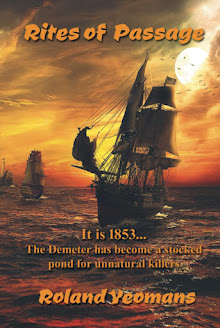
Y is for YEOMANS ...Let me introduce him to you.

{The photo on this cover is in the public domain in that it was published in the United States between 1923 and 1977 and without a copyright notice.}
 
"The secret?
It is every artist's secret ... passion.
That is all. It is an open secret and perfectly safe.
Like heroism, it is inimitable in cheap materials."
- Willa Cather
 
Roger Zelazny, ghost here:

The ghost of Hemingway is presently keeping Roland company on one of his blood runs.

Hemingway is reminded of his own days driving an ambulance in WWI when he accompanies Roland.

So it is left up to me to talk to you mortal writers.

Most of you are scoffing that the ghost of Roger Zelazny is currently typing his thoughts to you.


Impossible you say.

You, and the rest of mankind, are quite sure what is possible and what is impossible.

In the daylight.

When the night descends, the stride of your thoughts is not quite so confident.

Not so Roland.

He is much like an animal. I do not mean that as an insult.

He takes what comes at face value, not forcing it to fit into any preconceived notions Man teaches as Science.

He deals with what comes without protesting that it cannot be, only seeing what is and adapting.

Perhaps that is why we ghosts are drawn to him. In him is that quality that Stubbs expressed in MOBY DICK:

“I know not what all may be coming, but be it what it will, I’ll go to it laughing.”


Not that he is overly optimistic about the world around him.  Despite being part Lakota Sioux, he still reads the Bible by his bedside. He often quotes:
“They sleep not, except that they have done mischief;
And their sleep is taken away unless they cause
Some to fall.

For they eat the bread of wickedness
And drink the wine of violence.”


That is Proverbs 4:16-17 for those of you interested in such things.


In life I was not.

I thought the love of God was like the light burning from the stars:

cold and distant.

Now, that I am a ghost …

but no.

There are some secrets the dead may not share with the living.

But the secrets on how to write well … they I can share with you.

Oh, you are wondering who I am.

Don’t be embarrassed. In life I wondered the same thing.

As I wrote earlier: I am Roger Zelazny.

I made somewhat of a splash in Science Fiction in the sixties, endured and evolved in the seventies and eighties.
I went the way of all flesh mid-way through the nineties in Santa Fe, New Mexico.

And Roland mourned me as a distant older brother
gone over the crest of the hill before him,
leaving him cold and alone.

Oh, and I inspired him to take up the pen and follow my steps into weaving tales in the genre I call Science Fantasy.

That I sparked the idea in him to be a writer drew me to him.

It was his gentle, quiet, amused nature that has made me stay. He looks on all the awkwardness of life with a sly smile that says, “You expected water to run uphill?”
 
But now I have an important question for you reading:

What makes one tale live, vibrant and riveting, and another merely flat, lifeless words on paper?

Not that any of us have a sure idea,
although Hemingway would glare at me for writing that.
 But we had a close enough glimpse of the answer
to make a living at what we loved to do:

Write.

What is the answer?

A joyous cry: “Come see what I found!”

If you can bring anew the childlike sense of wonder and awe
to your readers that the poisons of living
have drained from them,
you will have a loyal following that will not quit.

What words will do that?

Certainly not the same sing-song repeat and rinse
of someone else’s bestseller.

The words must tilt the reader’s expectations on its ear.
 Did you notice I said reader?

Not readers.

You are talking to only one
at the campfire of their imagination and curiosity.
If you think of your audience as readers,
you will talk AT them not TO them.

The author/reader relationship is intimate: friend to friend. “Look at this, man!”

One friend sharing with another something fantastic and wondrous:

The meaning of life in the skating sparks of the sun along the uneven facets of a piece of rock candy …

or striking fire down the razored spirals of a unicorn’s tusk.

If you are drawn to write, you do not need to be told the basics. You already have absorbed them from the masters:

Stirring plots, memorable characters, and absorbing ideas.

You must tap the humanity of the situations, of the people struggling against the tide of events.

Remember this is the Microwave Culture.

Your prose must be lean and spare, yet sing with the poetry of mystery and suspense. How do you do that?

Mind your surroundings.

Nothing is ever wasted to a real writer. Circumstances suggest. Events coalesce. The story will begin to flow like a shadow along the floor of your unconscious.

Once you have seen their shapes, the stories will exist as ghosts for you until you have pinned them to the paper. Perhaps that is why there are so many ghosts of writers in the Shadowlands.

We made our living from ghosts,
so reciprocity demands its due.

Sometimes you will have to post a Help Wanted Ad
in your unconscious to apply for positions in the story
and events that have called out to you.

Do not worry.
Within the hour, your unconscious mind will have them lining up for you to consider.

Read your work aloud.

Hear the clumsy prose misstep that jars your ears?
A sentence is too long? Make them two.
A word unneeded? Remove it.
Sand your prose as a sculptor would his carving.

Give your characters life by giving them a new take on what it means to be human, to be fully alive.
Most people you pass on the streets are sleepwalking
from long years of debt and unfulfilled passion.

Give them hope that there is more out there,
that each corner could reveal the start of an adventure
that might shorten their lives but awaken their souls.

Do that and you will become more than a writer. You will become an author.

Want to read more on how to be an author? Buy GHOST WRITERS IN THE SKY:

http://www.amazon.com/GHOST-WRITERS-THE-SKY-ebook/dp/B006Z1MAP6

I have several chapters in it as does the ghost of Hemingway, Twain, Faulkner, even Bruce Lee and Groucho Marx!


***

Monday, April 1, 2013

Z is for ZOMBIES ARE US!

 
Ghost of Mark Twain here.

And no, you ain't seeing things backwards, children. 

Roland lost a bet with me at Meilori's, so I get to start the A-Z CHALLENGE ball rolling.


Why, wouldn't life be infinitely happier if we could only be born at the age of eighty and gradually approach eighteen?

So I thought I'd start at Z and leave it to Roland and his other ghostly friends to work to A.

And if that riles you, I remind you who the beloved literary genius happens to be t'wixt the two of us!  :-)

Which brings me to ... Zombies!

Whoever thought those critters with terrible table manners would be as popular as they are in this cross-eyed age?  Certainly not this pilgrim.

Now, I am sure part of their popularity in this loving, compassionate society is the fact of seeing violence gleefully performed on seemingly deserving subjects:

Zombies can be killed in no end of creative ways, and since they don’t feel pain and are already dead, there’s  no real need to feel guilty about it ...

and life for most folks these moral-dented days it seems is running from the very concept of guilt, don't you know?

But I further propose, children, that your fascination with zombies represents a subpressed understanding that something is wrong—

morally wrong—with our culture.

Why, zombies represent the appetite divorced from nigh everything else. They are incapable of judgment, self-awareness, or even self-preservation.

Though they still move and act, they are not really alive.

They hunger and are never filled ... much like your average Congressman!

And why they ain't just hungry for anything—they specifically want to eat the living, and even more specifically the brain, seat of rationality and self control.

I submit that this rise in popularity of zombies reflects a rise in anxiety over the elevation of appetite in modern life,

a popular recognition that appetite has gotten out of control, and that unchecked, unreflective, and immoderate appetite is a form of the worse death imaginable.

What do you readers think?