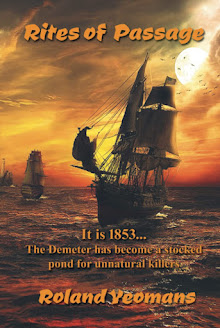
FREE KINDLE FOR PC

FREE KINDLE FOR PC
So you can read my books

Sunday, August 16, 2015

HOW TO MAKE HISTORICAL FANTASY REAL


History whispers its truth to anyone who will take the time to go where it lives. 
 - Meilori Shinseen


Where does history pulse with imperfect life?

In journals, diaries, and personal letters.  

Read the diaries of Mark Twain, the personal letters between John and Abigail Adams, the recollections of Nikola Tesla, 

and you will be astounded how their vital personalities leap from the pages.

You will sit and wonder over what you've read and still not know their hearts.  But you will have clues.  

What we write, even in non-fiction, is not truth.  It is only a mirror reflecting our own truths, our own souls.

Milo Fowler once asked me to write on how I incorporate historical figures and settings into what I write.

I can only tell you my truth.  Yours will be different.

INJUSTICE propels me.  And injustice leaves its bloody footprints down through the ages in the history texts.

Watch the movie, KHARTOUM, 

and you will see petty politicians wash their hands of the great unwashed in Egypt 

... and of the hubris of two flawed warriors of God.


Two of my historical fantasies were born of that time and of my fascination with the myths and Alien gods theories of ancient Egypt.


The "Alan Quartermain" of my linked world is the undead Captain Samuel McCord.  The law is not as important to that cursed Texas Ranger as is justice.

As I read history, I think: "How would McCord deal with this injustice?"

Have you ever tried to do the "right" thing?  How did that work out for you?  

Those with power think that might gives them license to play out their plots for even more power.  

Loosening one end of a political knot always seems to tighten it at the other end.

The beginning of our current situation in the Mid-East was sown in 1895.  

The personalities of those days are revealed in their letters.  Take Winston Churchill - 

his MY EARLY YEARS paints a world any writer would ache to meddle with.

So I meddled ... or Samuel McCord did ... for the best possible reasons that always seem to backfire for him as they do for many of us.

In a strange way, STAR WARS seemed more real to me than STAR TREK.  

The ships had dings, never worked quite right, and Han Solo shot first when it would save his life.

Your hero is only as good as his flaws which must be epic but understandable if your reader is to root for her or him.

McCord's greatest flaw is his love for his mysterious wife, Meilori, to whom Aztecs dragged screaming sacrifices ... while she smiled.

You must make your love interest rooted in human nature, alluring yet dangerous -- for men love bad girls.

And your hero's enemies must be epic as well.  Historical enemies ground your novels in reality.

Take the figures you are drawn to in history.  Your fascination will spill over onto your readers.

I have always been fascinated with Abigail Adams and Empress Theodora of the Byzantine Empire.  

They were strong women who thrived in times when women were hard-pressed to be seen as equals by men.

How to bring them into McCord's world?

Why not make them my special strain of vampire?  And leaders of their own undead empires?  

To have McCord stand in their way as they fought one another for control of the rest of the world seemed guaranteed to create impossible situations for my hero to escape.

Fantasy become real when your reader nods her head, buying the agenda that drives all the characters in your drama.

There are no villains ... merely strong-willed individuals whose cherished agendas strike sparks from other strong-willed people.

Ask yourself questions:

What would the Abigail Adams of her letters become in defense of the country that she and her husband sacrificed so much for?

How might undead Abigail react to the hero-worship of a young girl?

How would Empress Theodora, the daughter of a bear trainer and wife of an emperor of savage days, view human life?

How would her worldview differ from a Texas Ranger's whose code of honor was born of his educated parents and Apache mentor?


What was the daily life like for the British overseers of Egypt in 1895?  

How did it differ from the common man on the dusty streets?  

What were the major sights of Cairo of that time, of the desert ruins?

How did one get from here to there in that time?  What were the smells and sounds along the way?


Tourist books of that time will inform you of many of those questions ... and more important of how the Egyptians, both upper, middle, and lower class, were viewed.  

Also they will provide clues to how people talked in that era.  No O.K.'s allowed in your dialogue!!

Take care not to info-dump on your poor readers.  But do have fun with the world, and so your reader will have fun, too.

Small details garnered from newspaper accounts of those days will lend depth and reality to your tale.

Make use of Man's knee-jerk denial of what makes him uncomfortable to explain why the magic of your novel blends without many ripples into the events of your narrative.

The more exotic and rustic your locale, the easier will the magic in your tale not be noticed by the world in general ... 

and so not jar the willing suspension of high school history lessons of your reader.

Find pictures or better yet videos.  It is all too true that a picture is worth 1000 words!


I hope I've helped in some small way.  :-)  Roland

Saturday, August 15, 2015

THE BLINDSPOT OF YOUR NOVEL


This shadowy nemesis of your novel lurks in plain sight.


I have talked of the importance of where and how to end your story and how it even tells you where to begin your tale:
http://rolandyeomans.blogspot.com/2013/01/where-do-you-end-your-story.html


I have spoken of the deadly crossroads of your novel: the middle
http://rolandyeomans.blogspot.com/2013/01/the-deadly-crossroadsthe-middle.html

But if you ignore the Blindspot of novels, you will fail in your writing a page-turner and a best seller.

Ever ridden an Old West stagecoach?


Six horses lurch against their collars in union, traces snap taut, metal fastenings clink and the stage leaps into motion.

You feel the coach pitch backward and then roll forward as the Concord gets underway.  If you are over the wheels there is a pitch and sway that can get you sea-sick.

In the other seats there is a violent thumping over rough ground.  Suddenly the stage violently pitches forward and jerks backward.

You brace your feet and clutch the armrest or the arm of the passenger beside you. But as the coach gradually steadies, you relax. The wheels have bounced over a deep rut that runs across both tracks of the road. 

Then, one wheel hits a gopher hole.  There goes your neck jamming into your shoulders and your bladder ramming into your sinuses.

Imagine hours of that.

That is what it is like when a reader is the victim of crude chapter transitions. 

Many lurches in a row, and you will lose the reader or at least blunt her enjoyment of the ride you worked months on.


Chapter Transitions


How a chapter ends should entice the reader to turn the page and move on. End on a climax or major "oh no!" moment,

and start the next chapter in a new location or time, and your reader might wonder what the heck they missed.

Think of chapter endings as a hand off. One ends, and it gives you the baton to run with the next idea.

Ask:
  • What do you want readers to take with them?
  • What do you want them to wonder or worry about?
  • What are you teasing them with?
If you can't answer these, then maybe your chapters are just ending, and not moving the story forward.

You might also think about:

  • What mood do you want the reader to carry into the next chapter?
  • How are you manipulating the tension or pacing?
  • What themes might be continuing?
  • How will this transition feel to the reader?
These are also good things to think about for going from paragraph to paragraph.

Moving from thought to thought and line to line takes more finesse, and this will affect how the story reads.

How the narrative flows.

A big factor here is your stimulus/response. One thought leads to the next. One actions triggers another. Even if you segue into another idea, something made you do it.

If your paragraphs are filled with details that don't actually relate it can feel aimless.


Some things to ask:
 
  • Does every paragraph have a point?
  • Are there extraneous details that are shoved in because they "have" to be there?
  • Are you working too hard to force an idea or line in where it doesn't belong?
  • Are your lines leading the reader somewhere?
  • When you change ideas, is there something that triggers that idea or does it just change? 
  •  

 How did we get here?
 

Change in location or time without letting the reader know you've moved. 


This can also be confusing if you jump ahead in time, but aren't clear how much time has passed. 

Try informing the reading about the shift, either at the end of one scene or the beginning of another. 


Get there already
 

Too much time spent showing the transition.

Travel is a common problem area for this type,
and you show your character moving from one place to another, and often describe everything they see along the way.

In fact, this is sometimes the only reason
why you have them travel.

It's just an excuse to describe the setting. Try breaking the scene and just moving to when the next thing happens. 


Hyperventilation and Cliff-hangers


If every chapter ends with a  physical cliff-hanger, soon your poor reader will suffer from hyperventilation.

Think bicycle chain -- each link runs smoothly into the tooth of the next spoke and the next.  


Listen to my END OF DAYS ...
(PLEASE!  only a little joking there)


CHAPTER HEADINGS
Don't believe in them?  J K Rowling did.  I used them to end my chapters with a bang or ironic humor.  
Take Chapter Four: 

THEY RUSHED THROUGH LIFE:

In it, the Turquoise Woman chides brutish National Guardsmen that they failed to notice the beauty of yesterday's dawn as they rushed through life.  

Now, they would never see another.  And the Turquoise Woman speeds time all around them until they wither to ashes before her.  

When McCord arrives and asks what happened to the invading Guardsmen, a street woman laughs, "They rushed through life." 
End of chapter.

CHAPTERS' LAST AND FIRST WORDS


For several chapters to avoid reader hyperventilation, I blended a chapter's last words into the first words of the next.


 In Chapter 13: A GOOD TIME WAS HAD BY NONE, I ended it this way:


Victor sighed as he faded away, ‘And a good time was had by none.’
As pale as I had ever seen him, Samuel turned to Magda.  “What just happened here?”
Magda, looking as stunned as I felt, rasped, “I do not understand.”

 CHAPTER FOURTEEN
THE FIRST DAY OF SCHOOL ALWAYS SUCKS
 “I do not understand,” muttered Maxine for well over the hundredth time.
She might have become family with her defending Becca, but family could still be immensely irritating.  And Maxine was excelling in being irritating. 

I ended Chapter 14 and blended into the next this way:
The two Hellhounds chuffed as one.  The students slowly backed into the courtyard of St. Marrok’s.  I spotted Skeggjold glaring at me far in the back.
I stiffened as I heard Victor whisper in my mind.  ‘Don’t sweat it, Alice.  The first day of school always sucks.’


CHAPTER FIFTEEN
NONE RETURN THE SAME


 Becca yelled over the roar of the fan and its engine.  “I just want you to know, Trish, the first day of school sucked!”
We were half-way back to Meilori’s.  Toomey was taking his time, flirting with Trish.  Higgins was rolling her eyes at the sight.  Maxine just seemed to be having the time of her life, the winds blowing back her brown hair.


I did similar echoing of chapter titles at the end of chapters with blending the last words of one chapter into the first words of the next.

It makes for a smooth transition.  

What do you think?

What tricks do you use for smooth chapter, scene, and paragraph transitions?

***
"It appears that every step we made towards liberty
has but brought us in view of more terrific perils."
—from Woodstock, one of the Waverly novels of Sir Walter Scott, born on this day in 1771

Thursday, August 13, 2015

PUT ME ON YOUR BOOK SHELF!


 It is the era of The Great Gatsby.

America has spanned the continent, survived the War to end all wars,
 and bursts with false fire in the stock market.

Criminals are the new heroes. 
 Science is the new god.

And one lonely, undying man seeks to evoke an innocence that never was 
by making the first talking Western movie.

With his wizard, Nikola Tesla, Samuel McCord awakens an ancient evil.

Now, he must find a way to save those who have unknowingly become the prey 
to Something whose hunger never ends.


It is a troubled shoot that fledgling director John Ford tackles in the Badlands with Marlene Dietrich playing the mysterious Lady Meilori,

and young Errol Flynn and David Niven playing the fools both on screen and off.  

Scaled death comes down from the pinnacles in the form of evolved raptors driven from their caves by something older than the Badlands themselves.

McCord believes things cannot possibly get worse ... until his wife, Meilori, arrives to see who dares to portray her.

On sale in paperback NOW!

YOU DO NOT KNOW THE DARK_An untold tale of Victor Standish and Alice


 {Image courtesy of Leonora Roy}

"I shall tell you a great secret: do not wait for the Last Judgement; it takes place every day."
 - Albert Camus


YOU DO NOT KNOW THE DARK!
 

Come with me to a midnight picnic in a cemetery.
 

Victor Standish and his ghoul friend, Alice Wentworth, are having a midnight picnic beside the crypt of Marie Laveau:


“You do not know the dark, Victor.”

Alice’s eyes were blue fire, her translucent skin spun moonbeams, her teeth sharper than regrets.

I flicked my eyes over this midnight graveyard as empty now as it usually was in the light. 


Few were those who cared enough about those lost to death.  Adults these days shed all their yesterdays.

Guess because when the future turned out to be a cruel place, no proof of a better past was wanted. And then, the loss would be survivable. 


I smiled bitterly. I knew all about lying to yourself.

I forced a laugh, “Say again? I’ve lived years on the streets. I know the night all right.”

Alice gestured at the cemetery all about us. “You know city darkness … which is never fully black.”

She shivered. “There is power in the night, terror in the darkness. Here there are … things that do not believe in wrong or right … only prey and hunger.”

I gestured to the small basket in front of her on the sheet spread on the grass. “Speaking of hunger, I got you finger sandwiches.”

“What?” murmured Alice in her odd British accent.

“You know that child molester who got off on a technicality today?”

“Yes?”

“Well, let’s just say that he’ll never play the piano again.”

Alice’s strange eyes hollowed. “Y-You?”

I shook my head. “Elu … which is where the rest of the pervert went. Elu gets hungry, too.”

Alice sighed, “Is he going to attend this ill-advised picnic as well?”

I faked hurt. 


“Ill-advised? This is romantic with a capitol R. We first met in this cemetery, remember? Right here. In front of Marie Laveau’s crypt.”

“That night almost killed you, Victor! There are no thresholds in a graveyard! Nowhere for you to run to safety. Oh, no!”

I turned around to follow her horrified look. Marie Laveau flowed across the withered grass towards us.

Her face was glowing like an instrument of dark grace. She never died, never used her crypt. Guess she just thought we lowered property values.

I gestured to our right. “The addiction counseling center is that way, Fright Face.”

Marie husked, “You always a smartass, boy?”

I shook my head. “No. Sometimes I sleep.”

Alice whimpered as she looked to our left. The shade of her insane mother rose like mist from Hell's open gate in the center of a ring of black mushrooms.

“No, not Mother. Not her!”

Alice’s mother smiled a thing of nightmares. “I shall show you both pain like you never imagined.”

As if. 


There were more flavors of pain than false promises in a politician’s head. In my life, I had tasted most of them. It was part of the deep music, the big game.

I took Alice’s trembling fingers. “Everything important that will ever happen to you will involve pain. Like getting rid of in-laws and pesky neighbors.”

Marie laughed, “You be a fool!”

I shook my head. “I be Death’s son. And her I did invite to the picnic.”

Mother, in her traditional black robes, billowed behind Alice’s mother. The wraith blurred into smoke. Mother inhaled sharply, making a face as she consumed the essence of Alice's mother.
 

 “Tasted bad as I knew she would.”
 

Marie Laveau backed up, her palm held out uselessly. “The Gray Man say I can’t be dying!”

I turned to Alice. “Evil isn’t the real threat to the world. Stupid is. And it’s more common.”

Mother flowed to Marie faster than I could blink. She wrapped a sinewy arm around the voodoo queen. 


 “Death is a door one person wide. Let me show you what’s on the other side, waiting.”

Then, faster than fingers become fists, the two of them were gone.

Alice turned to me. “You planned this?”

“Ah, planned might be too detailed a term to use. I just thought if I made us big enough targets, those two would stop hiding in the wings.”

I winked at her. "Now, we can get back to our romantic picnic."

Alice gasped, “And if your mother had decided to let us picnic alone?”

I made an uneasy face. “It’s not good to hold on too hard to what-if’s. You’ll get muscle cramps.”

She lunged for me. “I will show you cramps!”

I sprang up, racing between crypts and tombstones as she flowed after me. “Your finger sandwiches will get cold!”

As we darted between mausoleums, Alice smiled wide. “Your fingers look warm to me!”

I sighed. Victor Standish, saving the world one stupid suicidal stunt at a time.

Wednesday, August 12, 2015

THE NEAREST THING TO LIFE


"Art is the nearest thing to life; 

it is a mode of amplifying experience and extending our contact with our fellow-men beyond the bounds of our personal lot.” 
-George Elliot


Our life consists of dateless moments between the cry of our birth, which we do not hear, 

and the rattle of our death, which escapes us even as we lose our fragile grasp on awareness.

Awareness --

We do not fully possess it in our own life and only delude ourselves in thinking we possess it concerning the lives of others. 

Everyone dies but does everyone live?

Take a diary -- Samuel Pepys or your own.

Once a life is contained, condensed, and compressed in the slim pages of a diary, it seems smaller somehow.

But, of course, it is not.  

Not anymore than a painting of the ocean shrinks it.  

In reality, the sea still stretches from horizon to horizon.

The events of life give birth to the question WHY? but does death kill all the answers to it?

Each of us must answer that last question for him or herself.

Strange is it not that the question WHY? follows us all the days and passages of our lives?

We never do seem to get an adequate answer to the most important times we ask it.

Take ...
 "Why are we here?"

You must answer that for yourself, of course.  But novels help us search out the answer.

 Books are safety-deposit boxes for 
human awareness, 
like urns that contain words not ashes.

As your mind sifts through the word-ashes of each book you read, you grow in awareness.

Those books that shine a light for you in the darkness of your questions 

become "classics" though that term is over-used these days. 

 The real, in fiction, is always a matter of belief

 - it is up to us as readers to validate and confirm. 

It is a belief that is requested, and that we can refuse at any time.

 Novels let us see the world and our place in it in ways no other medium allows.  

Movies tell us what to believe.  Novels make us do the heavy lifting ourselves --

And we grow stronger because of it.

“The great secret of morals is love; 

or a going out of our nature, 

and an identification of ourselves with the beautiful which exists in thought, action, or person, not our own.” 
 - Shelly


Again: 
Does everyone live?  

Look at the headlines.  Is there much self-awareness you see in the angry eyes of protesters the world over?


What do you think?

Tuesday, August 11, 2015

STEER CLEAR OF THESE WRITING MISTAKES


Don't you wish there was a map to follow to find success with your writing?

Each of us must chart our own course to our novel's successful end, but there are some shoals we should avoid:


1.) TOO MANY CHARACTERS

When more than just a few characters are introduced in the first few pages of a book, 

it’s difficult to keep their names and roles straight.

Have a literal boatload of characters?  

Filter them in slowly in the first few chapters, 

linking them in the mind of the readers with vivid sketches of their personalities.


2.) STERILE CHARACTERS

 If your characters are flat, if there’s nothing to set them and their struggles apart, we won’t want to cheer for them, and might not care enough to keep reading.


3.)  EXPERIMENTAL STYLE

When a writer experiments with style or structure, the result can be refreshing or irritating. 

Your ability to pull off something out-of-the-ordinary depends on your skill as a writer, 

and your ability to connect with readers despite your unusual style.

Anyone who has read my blog for long knows that I loved Roger Zelazny's books.  

But towards the end of his career, he experimented with strange formats to his books.

In DOORWAYS IN THE SANDS, he ended the chapters with cliffhangers, 

but then started the next chapter some time later, working back to the resolution of the crisis.  

VERY, VERY irritating!  

I only stayed because I liked him.  I don't think many other of his fans did. 


4.) UNCLEAR CHARACTER MOTIVATIONS

Have you ever read a book where a character does something, and you say, 

“Why on earth did she do that?? A mother would never do that!”

 Ensure your characters’ actions are in line with their motivations, 

and if they don’t appear to be on the surface, your reader must understand why not.

 Don't lift your readers out of your novel with characters you force to be stupid to get them to make mistakes to propel your story forward.


5.) HAZY STRUCTURE

  If all the good stuff happens at the beginning, or if nothing exciting happens until the end, your reader will be frustrated with the rest of the book.


6.) WRITE FOR THE MARKET ONLY

If you start by chasing the market, you study the bestseller lists and try to identify a trend, jumping on it.

Even if the trend is still hot by the time your novel comes out, the story will be lackluster, for it didn't come out of your dreams.


7.)  NULLIFY THE DANGER OR REACH THE GOAL TOO EARLY

The point is to raise the stakes so that the readers are not only cheering your protagonist on, 

but afraid that they may fail to save whatever it is that they are trying to keep.

 Regardless of your genre, 

every novel must have a protagonist trying to accomplish or reach some kind of goal. 

The plot itself is then the character’s journey to try to reach said goal.

 In some novels, that goal may evolve along the way, 

but the important thing is that whatever the goal is, it is out of reach throughout the large majority of the novel. 

By making your characters fail, often repeatedly, to reach that goal, 

you keep your readers hooked because they’ll want to find out how your character will manage to succeed.

What do you think are some deadly mistakes to avoid in our writing?

Monday, August 10, 2015

RIDING A BUCKING AURORA BOREALIS and how to get followers


"Even if you're on the right track,

you'll still get run over if you just sit there."
- Will Rogers.


Will Rogers, ghost, here:

So there I was perched atop a bucking aurora borealis,

trying to loop my lariet over a shooting star, 


when the ghost of Samuel Clemens ambled by.

"Need a favor, Will."

"I'm kinda in the middle of something, Sam."

"It's about Roland."

"Why didn't you say so in the first place? He needs help?"

"More than we can give. But his friends could use some, Will."

"How so?"

"They seem all fired up about getting droves of followers."

"Well, Sam, they could rob a bank. It worked for Dillinger."

"Yeah, that worked out real well for him, didn't it? No, you dumb Okie. Followers on that bog thing-a-ma-gadget."

I slipped off the bucking aurora borealis and nudged back my Stetson.

"Blog, Sam. On the internet. I read the papers. Wrote 4,000 daily columns in my time."

"That's what I'm talking about, Will! You know how to write.
 

You know how to perform. Why Zigfield trusted you with his fillies on stage."

"Old Zig didn't trust himself, much less anyone else.
 

But I get your drift, Sam. I'll write a column on how to snag followers."
 

***
 

And so here I am. 

Don't let anyone fool you. There are no rules for success. But that won't stop me from giving them to you:


1.) An onion can make people cry but there's never been a vegetable that can make people laugh.

Folks just naturally have more grief in their lives than they let on. They need an outlet.

You be that outlet. Make 'em laugh. You do that, and you'll have 'em coming back for more.

Or do you want to be a vegetable?


2.) Get someone else to blow your horn and the sound will carry twice as far.

How do you do that, you say. Easy. Blow theirs.

You find a gal or a fella who writes what you like, quote 'em on your blog. Add them to your blog list.

Be neighborly.


 You're leaving a comment on someone else's blog and spot a comment from them, say "Hi" to them in yours.

Agree with them (especially if you do) in your comment. Make a party line of it. Friendliness is catching.


3.) Good judgment comes from experience, and a lot of that comes from bad judgment.

You have to experiment to get anything outstanding done. Look at me and Wiley Post. We flew over darn near the whole world.


My daily news columns put momentum in the science of aircraft design and public support. And yes, we died in a crash.


But both of us died with a friend. Not a bad way to go.


4.) Know your audience and give 'em what they want by speaking to their hurts.

I went and read some of the blogs of Roland's friends. You folks are dreamers. 


We need dreamers today. Too many folks nay-say on the dreams of others.

You support those dreams in your blogs. 


Talk about what fears you have and how you fight them. 

It'll make the other gal in the cyber-trenches not feel quite so alone.How can you know your audience?

You know you, don't you? 


You know what you'd like to know about publishing. Research it. And then post what you found out -- with the links you went to.

Synopsis. 


Sounds like one of those ancient Greek philosophers. And most of you would rather kiss an ancient Greek than write a synopsis.

Well, research that subject. 


You find anything that makes the thing less painful, you publish it. And I guarantee you that folks will flock to your blog.

Remember fellas, there are more women bloggers out there than men. 


Be polite when talking about ladies in general.
Speaking of which, I'm taking my Stetson off to all you ladies out there. 


Forgive those hairy-legged gents, Ernest and Sam. They're just men. They don't know no better.


5.) Lettin' the cat outta the bag is a whole lot easier 'n puttin' it back in.

They call it the World Wide Web for a reason, folks. Think before you write. 


No "how many ______ does it take to change a tire?" 

Thing is, there are a lot of ______ out there no matter what _______ you're talking about.


An agent rejected you? Smarted some didn't it? 


I'd hold back on venting rage and spite on your blog. 

You jab in a knife, and you may pull it out, but the wound remains.


And remember a little thing called Google Alert. 


You rail about an agent, an editor, a fellow blogger --- that little gizmo will alert them. 

And there're a lot more of them than you.


So let's be honest with ourselves and not take ourselves too serious, 


and never condemn the other fellow for doing what we are doing every day, only in a different way.


*** 


So that's a little of what I know. 

I'm only a wandering cowpoke ghost. 

I mean, I never expected to see the day when girls would get sunburned in the places they now do.

And I've tried to be diplomatic. 


But I'm an Okie: 

to me being diplomatic is saying "Nice Doggie" until I can find a big enough rock.

One last thing: 


have, what is that phrase they use nowadays? Oh, yes, it comes to me now.

Have the back of each gal and fella you meet in your blog travels. 


Who knows? They may do the same for you.
***