Posts


I. THE PROBLEM
Your reader may think she knows what the problem is.
If you've done your work right, they are wrong.
The problem is really a McGuffin
(a term coined by Hitchcock):
The McGuffin itself was not important to Hitchcock,
he only was concerned that "˜it be, or appear to be,
of vital importance to the characters.
In North by Northwest (1959) Hitchcock blatantly places the McGuffin
in front of the viewer
and yet he himself acknowledges that what you see is "˜his emptiest, most nonexistent McGuffin.
The plot of the film concerns espionage and a man's (Cary Grant) mistaken identity as a spy. Halfway through the film,
Grant is at an airport and finally has the opportunity
to question a Central Intelligence Agent about what is happening to him:
Grant: "˜What does he (the lead villain) do?"
Agent: "˜ Let's just say he's an importer and exporter."
Grant: "˜But what does he sell?"
Agent: "˜Oh, just government secrets."
II. WHAT DO READERS WANT?
FREEDOM.
Freedom from the mundane world that encloses them.
Create a story that an enthusiastic reader can talk about quickly.
Can the story be summed up in a few sentences?
How do you fire that enthusiasm in a reader?
Fire their imagination.
Make them want to live the adventure with the MC:
A unique setting.
Stellar writing.
An ending that rewards the journey.
III. A MAIN CHARACTER WORTHY OF THEIR TIME
Anyone who likes a good story will tell you
that what drives them to read on
is wanting to know what happens to that central character.
They want to follow this person’s journey from
the first page until its final conclusion.
And in order to make the reader want to remain loyal to this person,
they need someone who is compelling, who is charismatic and more importantly,
they want someone who is filled with intrigue and personality.
Not just a plain persona made out of the heroic mold.
They want someone who they can relate to, someone perhaps they can see themselves as being:
Odysseus, who longs to return to his family and kingdom;
Frodo Baggins, who desires to spare his homelands from the ravages of war;
Harry Potter, who must face a destiny that is beyond his control;
or even Henry V from the William Shakespeare play,
who must prove his maturity and ability to lead a nation in the fires of war and death.
IV. FLAWS:
No one wants to read about someone perfect.
Flaws make a hero. Character is destiny.
Perhaps your heroine believes a lie that colors her whole life
until she discovers the truth about herself.
V. BACKSTORY:
Usually it helps with the story, and with the character’s drawing power,
if the back-story is influential in what their personality is during the story.
Learning what happens to a man’s family is important to
why they are on a journey of vengeance, for example.
A man searching for redemption to a past sin is another good one.
To give your character reason for doing what they are doing.
For urban fantasy plots,
the more realistic and heartfelt the backstory,
the easier the reader will accept the fantastic elements.
VI. HIS OWN WORST ENEMY:
While a physical obstacle is usually required for the MC to have to face in the novel,
I always like it when the worst enemy that MC has to face… is themselves.
For a reader to read about someone who must face themselves
as well as a ‘traditional’ antagonist can strike a very personal chord within the reader.
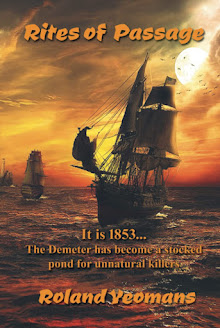
Captain Jack is certain he knows women
and couldn't be further from the truth!
VII. HUMOR:
Humor in books– especially children and teen books– is crucial.
It is the most important thing you could ever have–
barring a plot, literacy, a minimum of one character and possibly a functioning mind.
But you can get by without most of those– you cannot get by without humor.
The kid in all of us sees things as funny.
It sees the world as funny.
It has a knack for pointing out the ridiculous and the silly.
There is no greater comedian than the child in all of us.
It doesn't understand why something should be structured–
so it does whatever, whenever.
It doesn't understand what exactly the point of a conversation on one particular topic is–
so it spouts out whatever pops into its head.
This is the basis of randomness.
Barry Cunningham, editor for Cornelia Funke, Roderick Gordon and Brian Williams, former editor of JK Rowling, and founder of the Chicken House publishing company, put it the best way in an interview:
“I think humour is so important in children’s books
and you find children laughing
when they are scared and crying when they are happy.
And I cannot think that there is anything in life which is not essentially humorous.
Life and death and everything else.
That is the central portion of the child in me.
I absolutely believe everything comes as part of something else.
Like everything serious is funny as well, everything sad is funny as well,
everything scary is funny as well.”
Did you know that The Hobbit is better liked than the Lord of the Rings trilogy?
You probably did.
Do you know why it’s liked better? If you have a modicum of Jack Sparrow in you,
you can probably deduce the answer from the context: humor.
I remember laughing my head off at Tolkien’s explanation of how golf came to be.
The three trolls Bilbo Baggins burgles
have a hilarious conversation about how to eat the hobbit and dwarves.
Gandalf cracks a joke or two occasionally.
And all of this makes The Hobbit that much better than the Trilogy,
even though the Trilogy has so much more appeal fantasy-wise.
Victor Standish quips during the darkest times.
He is the clown prince of Snark.
I use humor to relieve tension,
To connect with the reader.
To lighten the mood of the preceding scene.
To hopefully have the reader tell a friend of one of
Victor's one-liners,
increasing word of mouth.
Do you feel comfortable with writing humor into your stories,
or do you tend
to shy away from it?
What do you think is most difficult about writing
humor?
{Jack Sparrow is a copyrighted Disney character. I just bribed him with rum.}