Posts
Posts


Just how do you make the locale a character in your novel?
I am hardly an authority, having published no novels.
Yet, teaching classes in creative writing when I was a high school teacher has given me some insight.
What do they say? Those who can, do. Those who can't, teach.
If I were all that wise, why am I still not published? But what I do know I am more than willing to share. And what I know might just be so.
Just take what seems reasonable to you and fling the rest to the cyber-winds :
Each city whispers in its own voice. Your city. My city.
You know streets that whisper to stay away at night.
You know what scandal has stained some avenue beyond repair. You know what person's name is spoken in hushed tones long after he or she has died and been buried in your city.
Each city has its own personality. Like a human's, it changes with trauma, years of abuse, and moments of historic impact.
Lifting the veil from the distinctive features of the setting of your novel makes your whole narrative come alive for your reader.
But how do you do that verbal sleight of hand?
Details.
Some obvious to tourists. Some that you have to ferret out by research in the library, on the internet, or by listening to a local visitor to your setting.
Feelings.
How does your hero/heroine feel about those details? How have they affected the protagonist and those important to him or her?
Weave those details and emotions into a rich tapestry of irony and longing.
What shadowed corner of your setting is especially dangerous or emotion-laden to your central characters? Why?
Paint a passage where that tapestry flutters in the shadows, not quite completely seen but more evocative because of that.
Time.
What era is it in your setting? Has your protagonist lived through more than one era of time in it?
How has the passing seasons shaped his/her mind, opinions, and outlook for the present? For the future? How does your protagonist view his and the setting's past?
As for FRENCH QUARTER NOCTURNE :
I worked on the streets of New Orleans for a time so the images, smells, and despair were fresh in my mind.
Which was a help and a hindrance. What one written detail brought into focus for me would not be in the memories of most of my readers.
I had to enter the blank slate of the reader's mind. Evoke in him/her an archetypal detail of touch, taste, and sight that would paint a landscape of the mind.
Every reading experience is a collaboration between reader and author in that way.
No two readers will take away the same mental images from the same author's words because each reader has his own distinct treasure-trove of memories and beliefs.
Still every author must bring his readers into the "now" of the novel's locale.
Not just by sight but by smell and by touch -- and even more important by the emotions evoked by each of those details.
Go from the universal to the specific with words. Meld detail with the characters' emotions.
In FRENCH QUARTER NOCTURNE I used actual quotes of politicians at the time of Katrina to ground the reader in the reality of the hurricane's aftermath, slowly melding the fantasy aspects so that the fantastic became more acceptable.
And at the same time, I used specific sensory details, blending them in with the main character's emotions to give the locale a personality of its own.
I like to think I succeeded. Only an accepting agent, publication, and the readers will tell. I hope this has been helpful in some small measure.
************
And here's a little glimpse of Paris :
Tuesday, July 6, 2010


Monday, July 5, 2010
DOES YOUR NOVEL HAVE A SOUNDTRACK?
 {A ripple from my July 4th post} :
I've been told by many that they no longer watch old movies. Pity. There are some great ones out there. At least try CASABLANCA or GOLDEN EARRINGS.
My introduction as a very young boy to the world of adventure, mystery, and love was done courtesty of the weekend classic movie marathons.
It was where I first met Marlene Dietrich. I first saw her in the the movie, GOLDEN EARRINGS. On my wall of Movie Memorabilia is the framed original sheet music for the movie, autographed by Marlene.
Even though I was a very young boy, I fell in love with her portrayal of the gypsy, Lydia. Of course I imagined I was the escaped British prisoner, Ray Milland, on the run from the Nazi's in Germany. It was the first movie she made after her three year gauntlet entertaining the troops on the front lines.
Marlene came back from her three years on the front lines of WWII very much changed. She never got over the horrors she saw there. She slept for months in jeeps, on floors, even on bare dirt.
One afternoon after VE Day, she was walking through a little French village. All around her was rubble, and she couldn't understand why -- all the buildings along the street were still standing with curtains blowing frilly and snapping clean-crisp in their windows.
Then, she looked through one of the windows to see that there was nothing behind it. The fronts of the buildings were still standing, but everything behind them had been destroyed. There wasn't a single living person past the false fronts of those caricature buildings.
With her face cupped in trembling hands, she stood in front of that window, weeping silently, refusing to be comforted ...
"... for there is no comfort for the dead," she whispered.
*********
Ernest Hemingway also wrote this of her : "She is brave, beautiful, loyal, kind, and generous. She is never boring and is as lovely looking in the morning in a G.I. shirt, pants, and combat boots as she is at night or on the movie screen.
She has an honesty and a comic and tragic sense of life that can never let her be truly happy unless she loves. When she loves, she can joke about it -- but it is gallows humor.
***********
{Now back to our regularly scheduled post} :
Some things are universal and eternal : hate, terror, and love.
They are the subconscious melodies in the background of humanity's thoughts. It sounds surreal but it isn't : Mankind shares a soundtrack.
Music is the breath of humanity as a species. Anthropologists, evolutionary biologists, neurosurgeons, and psychologists attest to it. They belive the area in the brain which processes music actually gave birth to human nature.
Music predates agriculture. It existed before language. Its melodies promoted the cognitive development necessary for speech.
Americans spend more money on music than they do on prescription drugs or sex. On the average, they listen to music at least six hours a day. For many it is the breath of their daily lives.
In Sanskrit breath is called prana, the very breath of life.
That breath is filled with vibrations : the cry of a lost child, the wail of a bereaved mother, the shattering of a store window. So many sounds in a single night of terror, creating a haunting melody ... a French Quarter nocturne for a mortally wounded city. Its name?
Katrina.
I was one of its notes.
Though I have a Master's degree in Psychology and a Bachelor's degree in English education, I, like so many others, survived as best I could. And so I found myself working as a blood courier to New Orleans in order to support myself. I used that experience to aid me in writing the Noir Fantasy, FRENCH QUARTER NOCTURNE.
With a name like that, it involves music. How could it not? Its actions centers in the French Quarter, the birth place of jazz.
It is important to the lead character, Samuel McCord, too. It is no coincidence that he owns a jazz club. A jazz club he named after his wife, Meilori. Music to him has become a remembrance of shadows, an echo of times spent with friends, and a glimpse back into a time when he was loved.
He is a monster who mourns the loss of his humanity. So much so that he nutures it in the souls of those who pass his club, lost and hungry. McCord sees life in terms of music. When he first views the flooded streets of New Orleans, he hears Bette Midler singing, "I think It's Going To Rain Today" ...
... especially the refrain "human kindness is overflowing."
He championed the tragic jazz legend, Billie Holiday. His wife's favorite song was Billie's "You Go To My Head." He hears it throughout the novel. And when he is facing his death before overwhelming odds, he once again hears that song before murmuring the one name he promised himself would be the last on his lips :
"Meilori."
And why is all this important to you as a writer?
What is the musical score to your novel? Every good book has one : stirring, haunting, light with laughter, or heavy with sorrow --
or all of the above. The music of your novel is the heart of your novel. And the heart of your novel is your pitch to the agent.
Think of the image on the posters for the past five movies you saw. It evoked a sense of the story to the movie. If you could look into the past, it would have been the essence of the pitch to the studio heads for the movie itself.
Like every good melody, the structure of your novel is comprised of two intertwining themes :
A) The physical goal of your hero ... what she/he wants.
B) The spiritual goal of your hero ... what she/he needs.
The A theme is what attracts the agent/reader to your story. The B theme is what keeps them there, what brings them back to re-read it again and again, making your novel a classic ... and a bestseller. Why not work to make your novel one of the great ones?
Music is all about transformation. You are not quite the same after hearing a good song. A good novel is about the same thing : transformation. Your hero has emerged transformed at the end of your novel, taking your reader into the process.
It all comes down to that one moment of faith : when your hero takes that leap into the darkness, not knowing if he will survive -- only knowing he would not be able to live with himself if he did not make the attempt.
*****************
Sunday, July 4, 2010
HOW TO MAKE YOUR TALE MEMORABLE
 The sound of a book hitting the floor hard awakened me. I pried open protesting, heavy eyes. They flew wide when I saw her.
Marlene Dietrich.
In a frilly black night wrap and not much else. She rose like the ghost she was, picked up the book and threw it down once more. Harder.
"Deine mutter hurt in der stadt!"
"Ah, do I want to know what that means?"
"No!"
She spun her ghost chair around, sitting with easy grace upon it so she leaned upon its high back, and looked hotly at me. "THE PASSAGE! Its author ... oh, there are no good English words. Dorf trottel!"
Marlene smiled wickedly. "And no, you do not want to know the meaning of that either."
She shook her head. "It is like listening to a good joke told badly. Much build-up for little pay-off."
Haunted eyes stabbed into me. "Liebling, the end of the rainbow is just another lonely place where hopes and dreams slowly fade away."
Her long blonde hair slid to half cover her face as she leaned forward. "Do you want that single moment they call fame ... or do you want to touch the heart?"
"You have to ask?"
Her smile illuminated her lovely face, showing the lonely soul within. "Ah, Ich liebe dich."
"Do I want to know the meaning of that?"
Her smile rivaled Mona Lisa's. "No, but later, if you are lucky, I will show you anyway."
She suddenly frowned. Not bending to pick up the book, she merely pounded a pretty foot on it. "He wants that moment ... and the money that writing bestsellers will give him. Ha. He promised vampires and gave endless pages of literary backstory. Bah."
She jabbed a long, slender finger at me. "You want to touch the heart, to write a story that others will come back to again and again?"
"Certainly."
"Then, you must give them dreams, danger, mystery ... and most importantly, you must give them love."
She sat up, running those long fingers through her wavy tangle of hair. "And you must not make it easy, liebling. There must be two problems : one inside the hero -- one outside him."
She looked intently at me, her eyes sparkling like knife points. "Your hero must be his own greatest enemy not some Nazi. Nazi's. Ha! They give him something to hit when he wants to hit himself."
Marlene sighed, her eyes looking into places that seemed to break her heart. "If we have the wit, we can conquer those who would bind us. But against ourselves ...."
She bowed her head, slowly raising it. "Against ourselves, we need help. We need love. The fire burning from one good heart will draw us out of the darkness of ourselves and onto the road leading to healing, to the light. Perhaps not triumph but ...."
She hugged herself. "Ah, but to die in the arms of one you love and who loves you ... that is a victory no Nazi can take away."
Marlene tapped the laptop by my bed. "Here is the stuff dreams are made of, liebling."
Her eyes looked beyond me. "Set your stage quickly. Bring all the players on stage in the first three chapters. Be honest with the audience : let them know who the hero is so that they can attach their hearts to him or her -- tell them the theme :
does money equal success, does fame, or does the trust of one good man mean your life has not been in vain?"
She blinked back sudden tears. "Let the readers have fun with your heroes. Toss everything in the air. Snatch happiness and safety from their heroes. Give the hero one slim chance to get it all back. Take that all away."
Marlene smiled bitterly. "Life is quite good at that. But fiction, unlike life, must end well if you would have publishers buy your tale. Give them that happy ending. Oh, after much darkness, storm, and strife, of course."
Her smile was brittle. "Bring everything down to a single, seemingly impossible showdown. Make the enemy unbeatable."
Marlene's lips brushed my ear. "And unlike life, let the good guy win and come away wiser, better, stronger."
"Marlene?"
"Yes, liebling?"
"You did walk away a winner : stronger, wiser, and better."
Marlene cocked her head, letting her hair become a wavy waterfall.
"Dass Liebe, die aus Trümmern auferstand,
Reicher als einst an Größe ist und Kraft."
In a husk, Marlene translated,
"And ruin'd love, when it is built anew,
Grows fairer than at first, more strong, far greater."
"Shakespeare," I said.
"Truth," Marlene smiled sadly.
*********************************************
***************
July 4th Post Script :
On one of Marlene's last pictures before WWII broke out, a lowly assistant director was sent home with a high fever, along with harsh words for ever having shown up. He awakened late in the evening to find a woman on her hands and knees scrubbing his kitchen floor. It was the star of the picture he was working on : Marlene Dietrich.
She had heard he lived alone and had brought over some hot chicken soup. Finding his kitchen floor could stand a washing, she was doing the job herself.
For three solid years during WWII, Marlene entertained our troops on the front lines, despite a death sentence on her head. She was with the troops in winter frosts and under broiling sun.
She bathed out of a helmet like an infantryman, slept on the ground, and refused to be evacuated when artillary pounded the ground around her. She was willing to do anything to amuse the troops : playing musical saw and wearing a jeweled sheath over long G.I. underwear to parade to the sound of enemy fire in the distance.
3 years. And she didn't make one movie all that time and cared not a bit. She was awarded the Medal of Freedom. Hitler would have given her a bullet ... after long hours of torture.
Ernest Hemingway wrote of her : "If she had nothing more than her voice, she could break your heart with it. But she has that beautiful body and the timeless loveliness of her face. It makes no difference how she breaks your heart if she is there to mend it."
Saturday, July 3, 2010
DO YOUR CHARACTERS WALK THE WALK?
 You've heard it before :
"Oh, you can talk the talk, but can you walk the walk?"
I'm asking that of your characters in your novel. Can they walk the walk? Does their walk match their talk?
In thirty seconds, an Intelligence profiler can create a frighteningly accurate character sketch of anyone they meet. People shout who they are without saying a word : the way they hold themselves, meet or don't meet your eyes, and the way they walk when feeling unobserved.
If you take care in your craft, you can make the reader believe your character is real, suspending that third wall between them and the pages you've written. The way someone moves is sculpted by ...
THEIR PAST :
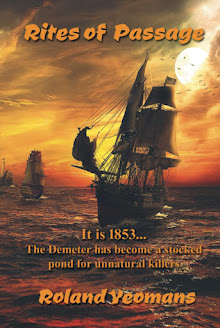
{As in RITES OF PASSAGE where McCord is in the cabin of a murdered seaman and being invited to a mysterious meeting with an Elder God by his oldest servant.}
He was a bent shell of a man, wrapped in feathered robes with Aztec markings on them. He fit in with the Victorian elegance of the steamer as much as I did, which meant not at all, but he seemed to enjoy the jarring note more. I know he enjoyed the sound of his voice more.
“The Mark of the Rabbit has come again.”
“I promise to tidy up better next time, frypan. But I have to run now.”
“Yes, to where Emperor Ketsahl Koahtl demands your presence.”
Webster frowned, going pale. “What does the Emperor of Peru want with the Ranger?”
The withered man smiled and bowed low. “I am but a poor servant, told nothing of why and much of what.”
He smiled as his eyes glistened with a cruel light. “But I do believe that the Emperor knows the identity of the murderer of Rachel Houston.”
Sir Lionel huffed, “Confound it, man! It’s obviously a trap. Steer clear of this one.”
I nodded. “Tell your master that you got too smart for your own good, and I passed up his gracious invitation.”
His fear was a yellow-green fire only I could see. But the others saw his wrinkled face pale. I noticed then how he held his shoulders - - as if they were permanently misshapen from long years of beatings. I sighed down to my spurs.
“Hold on there, partner. I’ll go with you.”
Sir Lionel drew himself up stiff. “Are you daft? No matter what is done to him, you owe him nothing. Certainly not walking into a trap.”
Greeley shook his head at me. “He would not do the same for you.”
I felt Webster’s deep-set eyes on me as I said, “It’s not what I owe him, but what I owe to myself.”
“Which is?,” rumbled the ambassador.
“To not be the kind of man that would knowingly let another get hurt if I could stop it.”
THE WAY A PERSON MOVES IS AFFECTED BY HIS AGE :
{As again in RITES OF PASSAGE when McCord is approached by Ralph Waldo Emerson on the deck of the DEMETER.}
I heard brittle laughter coming from behind me. I turned to face it.
Emerson. His disapproving hawk nose stabbed at me with only a little less force than his eyes. He strolled stiff-legged to me. I sighed. When you were young, you walked with your whole body. When you got older, you moved with just your legs.
“I was looking for Margaret," he sneered. "But this scene will do nicely enough instead.”
“If I promise to miss you, will you leave?,” I said.
A PERSON'S WHOLE FACE IS SOMETIMES SHAPED BY THEIR PROFESSION :
{As in this scene from CAPTAIN OUTRAGEOUS, as Victor Standish is walking beside Sam McCord -- the boy just having been rescued from living shadows by the undead Ranger.} (The novel is told through the eyes of the 12 year old street orphan.)
I looked up at him as I walked beside him. He moved like a cat but reminded me of a lone wolf, never at rest, always alert. The shadows seemed to move aside for him as if afraid of this strange cowboy. His amused eyes flicked my way.
"I reckon if I gave you a pair of cymbals, I could arrange for you to move louder."
"Hey, on these streets, you sure don't want to surprise anybody. A guy could get dead quick that way."
He smiled crooked, "Didn't seem to work that way with the Amal back there."
He winked at me as if at some shared, secret joke. My eyes blurred. Damn it. I was too old to cry. And certainly not in front of him. But for the first time in ... hell, for the first time I could ever remember ... he made me feel as if I had worth.
Clearing my throat and eyes, I pointed to his Texas Ranger badge. "You really a Ranger?"
"Yep."
"Retired?"
He shook his Stetson-covered head. "No. On medical leave."
"For what?"
"For a long time."
His wolf eyes said he was laughing with me not at me, and I frowned, "You don't have cop eyes."
"What kind of eyes do police officers have, Victor?"
Police officer not cop. I tucked that bit of information about this McCord into the dark of my mind. "They have cold eyes, sir."
"Call me Captain Sam. And you haven't seen my eyes angry."
"Oh, I saw you back there with the Amal. I know you can get angry. But not cold."
I tapped my chest. "It's like the fire inside here has died somehow. You can see it in their eyes. And the way they look at you. Brrrr. Like you were a bad piece of meat. Like they were sizing you up to see if you're worth killing or just beating up."
I ran my fingers through my shaggy hair. "I've seen them off-duty. They look at everybody that way. Why is that?"
McC-- Captain Sam sighed, "They've seen a lot of folks at their worst, son."
"I bet you have, too."
His eyes grew so sad I thought he'd cry, and he whispered, "Yes, Victor. Yes, I have."
"But your eyes stayed warm."
He smiled as if it hurt him. "I've also seen a lot of folks at their best ... even when it killed them."
A CHARACTER'S MOVEMENTS CAN BE DICTATED BY THEIR NATURE OR THEIR VERY SPECIES :
{As in FRENCH QUARTER NOCTURE when McCord and Renfield, the vampire priest, leave their meeting with R'yleh, the leader of New Orleans' colony of Soyoko {evolved raptors.} They meet a wheelchair-bound Maudie and her little dog, Tufts, in search of the Ranger to seek his help for the Convention Center being overrun by drunken young gang members.}
Maudie jabbed a gnarled forefinger at Renfield. “I heard stories about you and the cowboy. How you fought the Nazis, mobsters, commies, and crooked politicians. You mean to tell me a bunch of wet-nosed, drunk punks are too much for the two of you?”
Renfield closed his eyes, probably seeing many of the same ghosts I was seeing, and murmured, “And there are rows upon rows of the graves of innocents who paid the price for our so-called heroics.”
“So you just gonna throw those poor little girls to those raping bastards and to hell with the --”
She looked over my shoulder and went terror stiff. Tufts froze and began a low growling. I turned. R'lyeh. She was standing at the edge of the garden alleyway and swaying slowly.
Slit-eyes studied Maudie for long, hungry moments. They reflected the cold fire of the full moon. The moon of death and endings. Those eyes seemed to murmur of her race's beginnings that lay lost and buried back beyond the dark oblivion of pre-history before there were mammal hands to chisel words into rock or brush blood upon cliff faces.
There was something familiar to the way R'lyeh moved. Then, I realized what it was. I recognized the rhythm. I turned back around, studying Maudie’s neck pulse. Crap. R’lyeh’s swaying was matching the beat of the woman's heart.
I rose slow, ignoring the pain in my right knee, and faced the Soyoko. “She is not prey.”
“Why not? She is old, dying. And you heard her. There is no law to stop me.”
The angry rumble of the thunder above seemed to merge with the sound of my voice. “There’s me.”
*****************
There are more things that affect the way your character moves : attitude, health, environment. Look at the characters in your novel : do their movements reflect the different elements of their world, their nature, and their expectations? If not, polish those movements. Your novel will shine the better for it.
***********
Study the facial expressions and the body movements in this music video to see better what I am saying :
YOU'VE COME A LONG WAY JUST TO DIE
 {My posts read easier at 125%}
I've had emails from some of my new visitors. They're unfamiliar with Samuel McCord. They ask : just who and what is he?
I thought I would answer in this post from the first chapter to NOCTURNE'S sequel : NEW ORLEANS ARABESQUE. As we enter Samuel McCord's life, it is two months since Hurricane Katrina devastated New Orleans. He has emerged from his quarters in his jazz club, only just recovered from the injuries sustained in rescuing Death herself from a realm some call Hell :
CHAPTER ONE : IN THE HUSH OF A DYING CITY
Meilori's. Where death, life, and undeath sit at the same dark table. Still and all, it was my jazz club, and I loved her. Sort of tells you what kind of man I am, right?
Wrong.
Even I don't know what I am. All I know is that I can't die. Am I a revenant? Wash out your mouth and get that giddy look off your face. You really have no idea the horror that a true vampire is. Sadly, neither do they. Denial's not just a river in Egypt.
The blood of the entity called Death has mingled with mine. It was already an odd stew before then. Elu, my Apache blood-brother, was only half-Apache. His mother was the being the Apache called The Turquoise Woman and the ancient Greeks called Gaia. What did that make him, make me?
Screwed mostly.
Life isn't like Hollywood paints. Neither is undeath. There are no rules clearly written in some ancient, human-flesh bound book. Most children of the night don't know just what they are, what limits they truly have, and what secrets lay in their tainted blood. Life is never quite what you expect. Why should unlife be any different?
I stood in the shadows on the staircase leading down to the main floor of Meilori's. It twisted a bit so I was still hidden from those waiting for me at the front tables. I had maybe four beats of a living heart before they sensed me. I had known they were here from the moment they entered my club without my invitation. My club and I are linked like that. I drew in a deep breath that I didn't need to collect and center myself.
Somewhere in misty woods, lean wolves ran wild and free. Sitting on sandy shores, little children laughed at the lapping waves. Half a world away on mountain peaks, tall and unclimbed, the crisp winds sang their song of elusive eternity.
And standing here on these stairs, I was so weak from hardly healed injuries I actually trembled. I hurt all over. And the two leaders of the world's living dead waited for me at the bottom of these steps. Since they trusted each other about as much as I did them, they had brought their deadliest bodyguards.
I smiled like the wolf I was. Just another day for Captain Samuel McCord, eternal Texas Ranger. I had taken that oath some two hundred years ago. But I was still standing so it was still binding. Leastways, to my sense of honor it was. I suddenly pulled up straight and tall.
Down below, Diana Krall, Canada's queen of the piano, had changed from "Boulevard of Broken Dreams" to "You Call It Madness." The last tune was our signal for a deathtrap. I cocked my head and listened close. The keys were being hit by trembling fingers.
My friend was terrified.
I felt my face become stone. Let the rest of the world go to hell. But here in the French Quarter, in my club, no one preyed on innocents. No one.
I stepped down and around the corner as I smiled my death grin.
"Empress Theodora. President Abigail Adams. You've come a long way just to die."
******************
Friday, July 2, 2010
THE ART OF DRIVING IN POURING RAIN {AND WRITING A QUERY}
 Among those killed in action on this day in 1916 at the Battle of the Somme was Alan Seeger (uncle of Pete Seeger), a twenty-eight-year-old poet who had gone to live in Left Bank Paris, and had joined the French Foreign Legion in order to fight in the war. From Seeger's "Rendezvous with Death":
I have a rendezvous with Death
At some disputed barricade,
When Spring comes back with rustling shade
And apple-blossoms fill the air —
I have a rendezvous with Death
When Spring brings back blue days and fair.
Now back to the title of this post :
The art of driving in the pouring rain {and writing a query.}
Yes.
There are similarities between the two.
For instance, the question :
SHE DOES SEE ME, DOESN'T SHE?
The truth? No. No, she doesn't.
In her mind's eye, she sees the face of her friend as she's talking into her Bluetooth headset. By the dashboard clock, she sees that she's 10 minutes late. In the rearview mirror, she sees the bouncing image of her lips as she tries to apply lipstick without ending up looking like Bozo the Clown.
But you? You she doesn't see.
Not to worry. Just drive as if everyone around you is going to do the stupidest thing imaginable, and you'll be just fine.
THE AGENT TO WHOM YOU'RE WRITING DOESN'T SEE YOU EITHER.
She sees the precious sleep she's missing by reading query after query into the wee hours of the morning.
She sees the worst pieces of prose from past queries that stick like cockle burrs in her mind.
She sees the long list of things she has to do the next day on less sleep that she wanted.
She sees the sad face of that editor saying "No" to her earlier in the day when she was so sure he was going to say "yes."
She sees the mounting bills she has to pay ... BUT SHE DOESN'T SEE YOUR QUERY ... at least not clearly.
What do you do?
With a driver, you honk the horn. With a weary agent, you reach out and shake her awake to truly see your query for what it hopefully is : engaging and intriguing.
How? However you do it, you have to do it in 10 seconds. That's how long you have before her routine of "Wax on; wax off" is finished. Actually, it's read, yawn, reject.
For you to get through to her, it has to be a one - two punch. Hook of a title. Then, wham! A fascinating one paragraph summation:
PROJECT POPE : Robot priests construct their own Pope in their search for God. Then, the unimaginable happens. They find Him. {The classic by Clifford D. Simak.}
2nd Way Querying is like driving in the pouring rain :
JUST BECAUSE YOU CAN DO A THING DOESN'T MEAN YOU SHOULD.
Hundreds of thousands of drivers die needlessly each year by insisting on driving the speed limit in blinding rain.
In writing a query, you have fantastic leeway. You can write in any voice you choose. Frivolous. Condescending. Antagonistic. Suicidal, oh I repeat myself.
Your query is a business interview. Treat it as such and treat the agent as the potential employer. Be professional. Follow her website's guidelines. And show respect.
3rd Way Querying is like driving in the pouring rain :
YOU HAVE TO ALWAYS KEEP THE BIG PICTURE IN MIND :
In driving that is looking past the hood to at least 200 feet ahead of you. Flick your eyes from side to side to prevent nasty surprises. Keep looking at the rearview mirror to see what may be charging right at you.
In Querying :
Keep in mind the ultimate goal : intriguing the agent enough for her to want to read more.
You don't have to cram 500 pages of story into one page. In essence, you're writing a movie trailer. Remember the latest movie trailer you saw. Did it give the whole story? No. It teased, giving you the hero, the antagonist, and a glimpse of humor and danger.
And if you're beginning to despair that no agent will be interested in your novel, someone convinced a movie studio to spend millions of dollars on this :
Then, there's this song, an echo of yesterday's post :
Thursday, July 1, 2010
NO MATTER YOUR WINTER, SPRING WILL COME
 Your unconscious speaks to you all the time. Usually, the din of our present moment drowns it out. Usually.
But the unconscious is a tricky little bugger.
As I was driving today in the blinding rains, courtesy of long-reaching Hurricane Alex, a car darted recklessly in front of me. I drive as if everyone around me is suicidal and moronic -- so there was no accident.
Through the blurred windshield, I spotted the bumper sticker on it. I thought I read : NO MATTER YOUR WINTER, SPRING WILL COME. When the windshield wipers sqeaked me a clear view, my impression wasn't even close to the true words of the sticker.
Don't ask. Just content yourself with the fact that it matched perfectly the mindset of a suicidal moron.
But it got me to thinking as I drove home. My unconscious mind was right. Life is a circle of seasons. No winter stays forever. No summer is endless. Trauma will end. Healing will begin. And no joy lasts forever.
My blog friends email me :
some are struggling in the middle of their novels;
some are just trying to overcome the inertia of pushing the beginning of their narrative over that first hill;
while others are brooding about revisions : where to prune, where to further illuminate.
Whatever season you find yourself struggling in, know that with the trials, there are also pleasures involved with each season. Both blessings and blights have expiration dates.
Life is both less and more than you may think. It is a fragile tangle of perceptions that exist in a fleeting moment in time.
This moment.
See? It is already gone : that moment when your eyes first spied the title over my post.
And that is something my half-Lakota mother taught me as we looked out over Lake Michigan at a frosty sunset while she spun me tales of the Twilight of the Gods, and what it meant to be courageous.
Suddenly, she turned to me and said : "Breathe each breath, little one. No two are the same. Remember the colors that paint this sky. Remember me, little one. Remember, and this sunset ... and I ... we will never leave you. Never."
Yesterday I wrote of Emily Dickinson. Writing of that sunset from so long ago has reminded me of her "Blazing in Gold." Here is a snippet :
"Blazing in gold and quenching in purple,
Leaping like leopards to the sky,
Then at the feet of the old horizon
Laying her spotted face to die…."
Another favorite comes from Christina Georgina Rossetti's "From Sunset To Star Rise" :
"I live alone, I look to die alone:
Yet sometimes, when a wind sighs through the sedge,
Ghosts of my buried years and friends come back,
My heart goes sighing after swallows flown
On sometime summer's unreturning track."
We write our tales, spinning them of the silk of our imagination and perceptions. We sail the dark seas of longing and desire ... to be published? No. I think we sail for a shore other than the need to be heard. No, we sail upon the Sea of Dreams to connect to others of like spirit out in the darkness.
That is why we sail upon uncertain seas to tell our stories ... to reach another heart like ours: hurting, hoping, and helping. That is a star worthy of charting our course by.
What did John Masefield write?
I must go down to the sea again,
to the lonely sea and sky,
And all I ask is a tall ship
See? It is already gone : that moment when your eyes first spied the title over my post.
And that is something my half-Lakota mother taught me as we looked out over Lake Michigan at a frosty sunset while she spun me tales of the Twilight of the Gods, and what it meant to be courageous.
Suddenly, she turned to me and said : "Breathe each breath, little one. No two are the same. Remember the colors that paint this sky. Remember me, little one. Remember, and this sunset ... and I ... we will never leave you. Never."
Yesterday I wrote of Emily Dickinson. Writing of that sunset from so long ago has reminded me of her "Blazing in Gold." Here is a snippet :
"Blazing in gold and quenching in purple,
Leaping like leopards to the sky,
Then at the feet of the old horizon
Laying her spotted face to die…."
Another favorite comes from Christina Georgina Rossetti's "From Sunset To Star Rise" :
"I live alone, I look to die alone:
Yet sometimes, when a wind sighs through the sedge,
Ghosts of my buried years and friends come back,
My heart goes sighing after swallows flown
On sometime summer's unreturning track."
We write our tales, spinning them of the silk of our imagination and perceptions. We sail the dark seas of longing and desire ... to be published? No. I think we sail for a shore other than the need to be heard. No, we sail upon the Sea of Dreams to connect to others of like spirit out in the darkness.
That is why we sail upon uncertain seas to tell our stories ... to reach another heart like ours: hurting, hoping, and helping. That is a star worthy of charting our course by.
What did John Masefield write?
I must go down to the sea again,
to the lonely sea and sky,
And all I ask is a tall ship
And a star to steer by.
*****************************
Post Script : If you would like to see how an agent truly views queries and the writers who send them, go to this delightful, enlightening post by agent, Anita Bartholomew of Salkind Literary Agency : http://www.editorsandauthors.com/
*****************************
Post Script : If you would like to see how an agent truly views queries and the writers who send them, go to this delightful, enlightening post by agent, Anita Bartholomew of Salkind Literary Agency : http://www.editorsandauthors.com/
Subscribe to:
Posts (Atom)