FREE KINDLE FOR PC

FREE KINDLE FOR PC
So you can read my books

Sunday, July 11, 2010

THE SIMPLE ART OF MURDER

Light drifted as a red fog in front of my eyes. I blinked them with an effort.

Consciousness teased me at the edge of the dark of my mind. I tried to move my hands. They were thick, heavy ... far from me ... not my hands at all it seemed.

"Son, you awake with all the clarity of a hot rock," softly laughed a familiar voice.

Raymond Chandler.

With that realization, I finally opened them. I groaned without words.

He was holding my dented copy of THE PASSAGE that Mark Twain had taken to show Ernest Hemingway. Gypsy, my cat, thumped off my bed and onto his lap.

In his ghost chair by my bed, Chandler made room for her by tossing the big book to the floor. "Don't worry, Roland. I only came to return this travesty of prose. Not to belabor the obvious."

"Ah, Mr. Hemingway ..."

"You know how prone to depression that old boxer is. He's still wandering the Shadowlands, muttering about million dollar book and movie deals."

"I take it you didn't like THE PASSAGE either."

He sat back in his plush leather ghost chair, scratching behind Gypsy's twitching ears. "What's to like?"

He filled his pipe with tobacco. "It is grim and depressing without any true sense of tragedy. You have to care about the people life mangles for there to be tragedy. And it's clear that Cronin doesn't care for his people so we end up not caring either."

He lit his pipe. "No, he just plays with his characters like a child with toy soldiers. And who cares when a toy soldier dies? A personality doesn't die ... just a pawn."

He bent down, picked up the book, flipped the pages for a bit then read : "He could no longer envision his parents' faces. This had been the first thing to go, leaving him in just a matter of days."

He looked at me, more sad than angry. "I had an uncle in Omaha, a minor and crooked (if I'm any judge of character) politician."

His eyes looked off into the shadows, becoming sadder. "As a very small boy I used to spend a part of the summer with him all the way up to the fall."

His voice softened with the remembrance of long ago seasons. "I remember the oak trees and the high wooden sidewalks beside the dirt roads ... and the heat and the fireflies and a lot of other strange insects and the gathering of wild grapes in the fall to make wine ... and once in a while a dead man floating down the muddy river."

He looked into the burning bowl of his pipe silently for long moments then turned back to me. "I remember all that. And Cronin writes that a man forgets the faces of each parent, dead at different times, after ... a few days? I regard his two sentences as disgraces to English prose ... and to the human heart."

His lips twisted into a bitter smile. "But he is a highly praised author while I am but a forgotten hack."

"As long as I'm alive you won't be forgotten, sir."

"You're not getting any younger, Roland."

"Gee, thanks, sir. You have any other reason to visit besides showering me with rays of sunshine?"

"The McGuffin."

"What?"

"Exactly."

"You've lost me."

He smiled crooked. "Not that hard to do so, son."

"I can see you've been talking to all my ex-girl friends."

I covered a half-yawn. "What is this McGuffin? And please don't say 'exactly.'"

He smiled wide around his pipe. "It was the hitch in Hitchcock."

"He made films. He didn't write books."

"Ah, Roland, each novel is a film. Every author is its director. You get to choose the angle of the reader's view of each scene. You choose the lighting, the stars, the script. Your film can be a work of genius."

He made a sour grimace. "Or it can be THE PASSAGE."

"You're singing to the choir, sir. You haven't said what the McGuffin is."

"It's the tagline to your book, Roland. The thing that grabs the attention of the agent and the reader ... and is just as meaningless as all the false fronts to the buildings on a movie set."

He smiled at my frown. "It's what Cronin was trying to use but failed. A McGuffin is a plot element that snares the viewer, drives the plot along, and essentially is not what the movie or novel is about at all."

"I don't understand."

Chandler chuckled. "Take Hitchcock's NOTORIOUS. A spy drama about Nazi agents and a plot to use the evils of uranium. A woman is sent to spy on her old boy friend, a Nazi. Surprises, suspense, and thrills ensue. But the essence of the movie is about two men trying to prove they love the girl. Who does she believe? And why?"

Chandler stabbed at me with his pipe. "That's where Cronin failed. You have to stay with the girl to care. She has to be center stage most of the time. Cronin spends so much time on backstory for characters who stray off the stage, the reader loses focus and attachement."

He stroked Gypsy absently. "Hell, you have to chew a third of the way through his book before you get to characters who stay awhile. Most readers will throw down the book long before then."

He leaned forward, still gesturing with his pipe. "Take NORTH BY NORTHWEST. Hitchcock himself says it contains his emptiest, most nonexistent McGuffin. Halfway through the film, the hero, cursed with being mistaken for a deadly American agent, finds out only his enemy is an importer and exporter of govenment secrets."

Chandler sat back. "That's all the hero gets for his explanation. But you in the audience don't care ... because by then you care for the hero, for his apparently doomed love for a beautiful, deadly girl."

I nodded. "It's like what my mother told me : "Life is staying with the one you brought. Loyalty."

Chandler nodded back. "Yes, tell your epic story. But tell it through the eyes of someone the audience can stick their hopes, worries, and heart on."

His long face shone with the light of a teacher. "The McGuffin is your tagline, son. But it will be your strong characters placed in jeopardy as they struggle for their heart's desire that will sweep your readers along."

He thumped his pipe on the book in his lap as Gypsy wrinkled her nose at the trailing smoke.

"These days movies and books are just McGuffins ... the idea without structure or characters to care about. Or worse, a tease, like a shill crying out at a carnival, promising one thing and delivering quite another."

Chandler sighed, "PSYCHO. Now, we know what it is about. But first viewers of the film thought it was about a stolen $40,000."

He smiled knowingly. "That robbery was only to get us into the Bates motel and a lovely young girl in jeopardy. In bloodier and sloppier fashion, the same could be said of FROM DUSK TO DAWN."

Chandler looked from me into Gypsy's heavy-lidded eyes. "The author is a magician, son. You distract with your McGuffin to hit your reader out of the blue with a sudden surprise and delight."

He blew out his cheeks. "But if the magician bores the audience to sleep with too much distraction, they are all nodding off when he pulls the rabbit out of the hat."

I smiled big. "You know, sir, you're the one who taught me how to write dialogue. And now this."

"How much are you paying me?," he smiled crookedly.

"Ah, nothing."

"I'm worth twice that." He grinned and disappeared.
************
Here is the trailer for Raymond Chandler's most famous novel and movie : THE BIG SLEEP :



MAGIC, HORROR, AND OTHERWORLD BEAUTY

What draws us to write?

It is a solitary sojourn. Most of us will never receive world acclaim ... nor do we expect it.

What then propels us on this journey? What swept you up when you first started to read for yourself? How often do you find a book which conjures that same spirit within you now?

Not often I would wager.

I believe we write to create that world which spellbound us into reading in the first place. What voices called out to us then? What lessons did they teach us?

For me the voices were :

Magic, horror, and otherworld beauty

These three sirens dominated my solitary reading of choice during my high school years. And their voices can be heard in the background of all that I write. Like the three fates, they weave the tapestry of my unconscious muse.

As a young child, I wandered alone into Edith Hamilton's MYTHOLOGY. In junior high, I joined the League of Five and group reading with BEAU GESTE and DR. FU MANCHU. In high school, I was alone again in my reading, open to any influence that caught my fancy.

The authors of those years were my unknowing mentors in how to write well. And oddly enough it was an artist who led me in the land where they all dwelt : Frank Frazetta. And he painted the first road sign on my path to becoming a writer :

1) OTHERWORLD BEAUTY WILL HAUNT YOU, BRINGING YOU BACK TO THE BEGINNING. {AND DON'T FORGET THE EYES.}

EERIE #23 : THE EGYPTIAN PRINCESS
When I spotted the cover to EERIE#23 with Frazetta's "Egyptian Princess" in a used book store, I was spellbound. Yes, she was clothing-challenged. But it were her eyes that ensnared me. And my encounter with her made me quite a few dollars lighter. EERIE #23, even back then when dinosaurs roamed the earth, was a collector's item.

From that moment on, I noticed eyes : weary ones , dull ones, evaluating ones, and those who were black windows into the nothingness that lived in the souls of those who possessed them.

As I began to write, I realized eyes could be the shorthand definition of the characters owning them. I noticed that when the eyes of strangers boldly met mine, it often meant the same thing as when Nixon proclaimed, "I am not a crook." I started counting my silverware.

But back to Frazetta. His art was vibrant, moody, and on-fire all at once. His paperback book covers led me to Edgar Rice Burroughs, Robert E. Howard, and even to H.P. Lovecraft. And those three authors sketched the second sign post :

2) HISTORY IS NOT WHAT WE THINK - THERE IS MYSTERY AND MAGIC UNDER THE TOMBSTONES.

UNDER THE PYRAMIDS by H.P. Lovecraft (with Harry Houdini)
My hands went into warp speed when I saw the Frazetta cover emblazoned with that title. Frazetta. Harry Houdini. Wow. I didn't know this Lovecraft fellow, but I had to see what kind of supernatural trouble Houdini had gotten into in his Egyptian travels.

And I wasn't disappointed :
The first sentence : "Mystery attracts mystery."

I was hooked. Then, came the terrible imprisonment within an ancient, dark pyramid. The clever escape and the final glimpse of horror :

"The Great Sphinx! God --

that idle question I asked myself on that sun-blest morning before . . .

what huge and loathsome abnormality was the Sphinx originally carven to represent?

Accursed is the sight, be it in dream or not, that revealed to me the supreme horror—the Unknown God of the Dead, which licks its leering lips in the unsuspected abyss,

fed hideous morsels by soulless absurdities that should not exist. The five-headed monster that emerged . . . that five-headed monster as large as a hippopotamus . . . the five-headed monster—and that of which it is the merest fore paw. . . .

But I survived, and I know it was only a dream."

***
From Frazetta, Burroughs, Howard, and Lovecraft ... I learned how history can be made alive and alluring ... and supernatural. It is a lesson that stays with me still.

3) ROGER ZELAZNY'S LORD OF LIGHT :

Perched in the used bookstore shelf right next to a Frazetta cover of a Conan novel was the book that was to teach me that prose could be beautiful and evocative without being stale and stiff. I picked up LORD OF LIGHT and read the first paragraph :

"His followers called him Mahasamatman, and said he was a god. He preferred to drop the Maha- and the -atman, however, and called himself Sam.

He never claimed to be a god. But then, he never claimed not to be a god. Circumstances being what they were, neither admission could be of any benefit. Silence, though, could.

Therefore, there was mystery about him."

{It is no accident that my own hero is called Sam.}

Mystery. Evocative imagry. I was hooked.

I became his student -- through his books, his essays, and his poetry.

Some of his words :

"No word matters. But man forgets reality and remembers words."

"For you see, the headwaters of Shit Creek are a cruel and treacherous expanse."

"I like libraries. It makes me feel comfortable and secure to have walls of words,
beautiful and wise, all around me. I always feel better when I can see that there is
something to hold back the shadows."

"There's really nothing quite like someone's wanting you dead to make you want to go on living."

"Occasionally as an author, there arises a writing situation where you see an alternative to what you are doing, a mad, wild gamble of a way for handling something, which may leave you looking stupid, ridiculous or brilliant -you just don't know which.

You can play it safe there, too, and proceed along the route you'd mapped out for yourself. Or you can trust your personal demon who delivered that crazy idea in the firstplace.

Trust your demon."

"I try to sit down at the typewriter four times a day, even if it's only five minutes, and write three sentences. It seems to get the job done. I've written a lot of novels."

And Roger Zelazny led me to this quote by Ernest Hemingway years before it made its way into the latest PREDATOR movie :

"There is no hunting like the hunting of man, and those who have hunted armed men long enough and liked it, never care for anything else thereafter."

THE SIGN POST MARKED DIALOGUE :

I have the eye-aching habit of writing long posts, so out of compassion for your eyes, I will leave that sign post to another day.
**************
And here is a glimpse of the Frank Frazetta Museum. His wife was the custodian of it. She died in 2009 after a year's valiant battle against cancer.

The children started savagely fighting over the paintings. Sigh. Charges of burglary and theft were lodged against Frank Jr. by the rest of the family on March 2010. Matters were solved on the surface. But it proved too much for Frank, mourning the loss of his beloved wife of forty years. He died this year on May 10th.

{In early 2000, he suffered a series of strokes, losing dexterity in his right hand. The champion that he was, he taught himself to paint with his left. The painting of the warrior fighting the Mastodon in the arena towards the end of the clip was done with his left hand.}

One of the prizes on my wall of Movie Memorabilia is a Frazetta lithograph of a bear {I like to think of it as Hibbs, the bear with 2 shadows, on a bad day} signed by the artist himself.
*******************


***

{The Frank Frazetta Estate owns all rights to Frank Frazetta's sketchbook.}

Saturday, July 10, 2010

MYSTERY AND WONDER

Mystery and wonder.

They were the elements that drew me into reading for myself.

I've talked earlier about how Edith Hamilton's MYTHOLOGY with its stunning illustrations by Steele Savage was the first book I chose for myself to read.

As a child I caught sight of mythic Proteus rising from the wine dark sea,


And heard shadowed Triton blow death from his wreathed horn.

Mythology and fantasy were the mid-wives of my imagination. And my tales show it. But I want to speak of what fiction I first chose for myself ... and what lessons I learned from those novels.

LESSON ONE :

{Mystery is the siren call for all lovers of fiction. Better to leave out commas than mystery in your tales.}

BEAU GESTE --
Its first sentence : "The place was silent and aware."

Mystery.

A desert fortress manned by the dead. Every French Foreign Legionnaire was standing at his post along the wall. Every man held a rife aimed out at the endless sands. Every man was dead.

Who stood the last dead man up?

That question drove me to check out a book as thick as the Bible. I remember sitting down that April 1st with my four junior high chums in study hall. They couldn't get over the size of the book. They looked at me like I was crazy. Then, I told them the mystery.

Tommy and Gary snapped up the remaining two copies in the school library. Raymond and B.J. (we called him Beej) had to go to the two different branches of the city library for their copies.

And then, my four friends, sluggish students at best, were racing with me through the pages to discover the solution to the mystery. But then came stolen jewels and desert danger. We were hooked.

Mid-way through the book, I discovered the classic movie marathon that Saturday was going to show BEAU GESTE, starring Gary Cooper and Ray Milland.

The five of us roughed it that night in front of the TV. After the movie, we planned on sleeping on the floor of my front room. It would be like we were French Foreign Legionnaires on a mission.

We were enthralled. We booed the bad guys. We cheered on Gary Cooper. And we sniffed back embarassing tears when he died.

But with the mystery solved, my four friends didn't want to go on. The solution fizzled the fun of the reading. We all moped. A throat was cleared. We turned around.

Mother sat with a leather-bound volume in her hands, and with her voice blessed with the magic of the Lakota Storyteller and the lyrical beauty of the Celtic bard, she smiled, "Let me read you five something --

LESSON TWO :

A GREAT VILLAIN WILL NEVER LET YOU DOWN.

{And he will keep your readers' interest up high -- so no lukewarm antagonists. Think epic. Think primal.}

Mother, in her rich, deep voice, read low like distant thunder :

"Imagine a person, tall, lean and feline,

high-shouldered, with a brow like Shakespeare and a face like Satan,

a close-shaven skull, and long, magnetic eyes of true cat-green.

Invest him with all the cruel cunning of an entire Eastern race, accumulated in one giant intellect, with all the resources of science past and present, with all the resources, if you will, of a wealthy government--

which, however, already has denied all knowledge of his existence.

Imagine that awful being, and you have a mental picture of Dr. Fu-Manchu, the yellow peril incarnate in one man."

She put down the book on her lap and intoned, "That, young ones, is the insidious Dr. Fu Manchu. Do you want to hear more?"

Man, did we! And so the League of Five was born.

For every Saturday night for the rest of that year and all through my last year of junior high, we sat cross-legged on the front room floor and listened to all thirteen of the Fu Manchu novels ...

along with the adventures of Sherlock Holmes, starting with "The Adventure of the Speckled Band." I never went to sleep after that without looking at my headboard!

LESSON THREE :
NOTHING LASTS FOREVER ... NOT THE BAD ... CERTAINLY NOT THE GOOD.

{Instill that truth into your tale, and it will intensify the fragility of the human body and the enduring courage of its spirit.


And if it teaches your readers to hold gently and gratefully the love they find, so much the better.}

Unknown to us, Mother was teaching us the value of a mind that thought beneath the surface, that grew stronger with use as with any muscle.

We made special nights of it when the classic movie marathon played any Sherlock Holmes or Dr. Fu Manchu movie. Flash Gordon with Ming the Merciless was great. It was like seeing Fu Manchu in a space opera.

But the seasons pulled us apart to different high schools, to different destinations.

Fatal car accident. War. Disease. Mugger's bullet.

Until now, only I remain of the League of Five.

But every April 1st, in the late evening hours, I sit down and pull BEAU GESTE from the shelf. I read aloud the words, "The place was silent and aware."

And no matter the room I find myself ...

it is silent ...

and it is aware.

I see five wide-eyed boys, their eyes gleaming with wonder and awe, listening once more to my mother reading into the wee hours of the morning,

her voice a beacon in the darkness of our imaginations.

I pull down my worn copy of THE INSIDIOUS DR. FU MANCHU and turn to chapter two with Sir Denis Nayland Smith's description of his adversary.

After a few moments, the words blur. But that is all right. I know the words by heart.

What novel meant so much to you that you just had to share it with a friend or friends? Tell me. I'd like to know.

Compare it to what you are writing now. Did it have any effect on your style or genre of writing? Please write me on that, too.
***********************


For Donna's Lakota friend and for those who wonder what Elu looks like :

Friday, July 9, 2010

PROSE AS BLUNT INSTRUMENT

A hearty cackle of laughter awakened me. I smelled pipe smoke. Now what? My eyes obeyed my order to open ... but reluctantly.

Mark Twain.

He was sitting in his ghost chair by my bed laughing so that his gray/blue eyes were wet with tears. I saw a thick book in his hands. A dented book. My heart sank. He was reading THE PASSAGE. The same book Marlene Dietrich had thrown down in disgust ... twice.

"Marlene warned me. Why this bejiggered paragraph goes on for miles," he chuckled. "Miles and miles and miles."

"Hi, Sam," I yawned. "So you hate THE PASSAGE, too?"

"Hate it? Son, I love it! Why this Cronin fella gives me more ammunition than James Fenimore Cooper ever did."

Gyspy, my cat, frowned at his smoke-reaming pipe. Mark Twain smiled a crooked smile and put it out. He shook his head, flipping two pages.

"Why this blessed paragraph is a veritable blunt instrument of prose. It assaults the eye, dulls the brain. With a paragraph that winds on for twenty pages, the words just fuzz together, don't you know?"

He smiled wide. "This Cronin boy sure seems in love with his words, don't he? He went and forgot the first rule of writing :

You need not expect to get your book right the first time. Go to work and revamp or rewrite it. God only exhibits his thunder and lightning at intervals, and so they always command attention. These are God's adjectives. You thunder and lightning too much; the reader ceases to get under the bed, by and by."

Gypsy jumped in his lap and curled into a purring ball beside the book. Mark Twain's face softened with a slight smile. He began petting her.

"This Cronin fella forgot that the time to begin writing your book is when you have finished it to your satisfaction. By that time you begin to clearly and logically perceive what it is that you really want to say."

I half-covered a yawn. "Well, he certainly says a lot in that book."

He jabbed his pipe at me. "And that's the bejiggered trouble, Roland. He says the story. He doesn't show it."

He punched the open pages with his pipe stem. "Take this here section. Why he goes on and on SAYING the story. There's fragments of history. Whole blamed generations of folks just talked about in too many pages. Then, there's Peter, his father, Arlo, Milo, Theo."

He shuddered. "I'm afraid to go on lest I see Hi-Yo and his sister, Silver."

He thumbed the pages, stopped, and yelped, "Lord God All Mighty, I see dialogue. Real honest to politician, quotation marked dialogue."

His face screwed up as if he had bitten into a sour lemon. "Not great dialogue. Not even good dialogue."

"Tepid, huh?"

"Tepid? Hell, son, it ain't even tepid. You'd have to scald it some to get it to tepid."

His gray/blue eyes suddenly lit up. "It comes to me!"

"What?"

"Why ain't he the clever one? He beats you over the head with page after page of blunt prose, saying the story, not showing it, until when he finally relents and grudgingly gives you some dialogue, you don't care if it has all the kick of a dusty tombstone, you're just so blessed relieved to see some, you start to cry."

"You really don't like his dialogue, do you, Sam?"

"Like it? It all sounds the same. All the men sound the same. Amy sounds like Auntie who sounds like ...."

He scratched his head. "I rightly don't know of any non-drooling girl that sounds like Auntie. Why, she's a little girl, right? But old Cronin has her spouting deep philosophical mutterings like some opium-addled poet. Sounded nice ... just not from a little girl. It jarred like nails across my mind's blackboard, don't you know?"

He wrinkled his lips. "Oh, Cronin did half-decent with that Wolfgang character."

"Gast, sir."

"You got gas, son?"

"Never mind."

"Where was I? Oh, yes, Wolfgang and Amy. He could have made all the time spent on his endless backstory worth it, if he had infected the man just a little. You know, making him the eternal father to the eternal little girl. Like THE ROAD but happier, don't you know?"

He fixed me with piercing eyes. "I think I might just have a ghost heart attack if that Cormac McCarthy ever writes a happy tale. Being an ar-teeest doesn't mean you have to depress the bejeesus out of us all the time."

He scratched behind Gypsy's ears. "It's clear there's one man who hates this book more than us, Roland."

"Who?"

"This Cronin fella."

"But he wrote it."

"Yes, and it's clear he didn't want to. Why he goes off on tangent after tanget before he finally drags his feet over to the horror that he promised. It destroys the book. Downright destroys it."

He stroked his moustache. "To get the right word in the right place is a rare achievement. To condense the diffused light of a page of thought into the luminous flash of a single sentence, is worthy to rank as a prize composition just by itself."

He cackled a dry laugh. "Anybody can have ideas--the difficulty is to express them without squandering a quire of paper on an idea that ought to be reduced to one glittering paragraph."

His eagle eyes turned to me. "You have a poet's flair, son. And even better, despite the lyrical beauty of your turn of phrase, I notice that you use plain, simple language, short words and brief sentences."

He jabbed his pipe at me again. "That is the way to write English - it is the modern way and the best way. Stick to it; if you're going to put flowers in, at least arrange them in neat rows. When you catch a stray adjective, kill it. No, I don't mean utterly, but kill most of them - then the rest will be valuable."

He nodded as if to himself. "They weaken when they are close together. They give strength when they are wide apart. An adjective habit, or a wordy, diffuse, flowery habit, once fastened upon a person, is as hard to get rid of as any other vice."

He glared at THE PASSAGE. "You know the first rule of writing is that a tale shall accomplish something and arrive somewhere."

"Ah, you already gave a first rule of writing, Sam."

"Who's the highly praised, beloved genius in this room, son? Like I was saying ... The episodes of a tale shall be necessary parts of the tale, and shall help develop it."

"That's not exactly what you were saying ...."

The rest of my words withered under his stare. "I was saying that the personages in a tale shall be alive, except in the case of corpses, and that always the reader shall be able to tell the corpses from the others. Even in the case of vampire stories, the personages in a tale, both dead and alive, shall exhibit a sufficient excuse for being there."

"That's an awful lot of first rules," I muttered.

Mark Twain stonily ignored me and thumped the book with his pipe. "Old Cronin went and forgot that."

His face lit up. "Ernie. I think I'll take this book to Ernie."

I went cold. "Ernie as in Ernest? Ernest Hemingway? Why he'll ...."

Mark Twain smiled wide and evil. "Yes, he will. Oooh, I sure wouldn't want to be in this Cronin's dreams tomorrow night."

He rose and softly deposited a sleeping Gypsy on my bed. "Mind if I take this durned book?"

Thinking of all the midnight guests I wouldn't be having, I smiled. "No. Take it, please."

His eyes suddenly twinkled. "I'll have Ernie bring it back."

"No," I groaned.

But Mark Twain was already gone. Gyspy opened one bemused eye then went back to sleep. Ever have one of those nights?
************
And here is Thea Gilmore with an audio lesson on how to paint with words :


Thursday, July 8, 2010

A REMEMBRANCE OF SHADOWS

Some of my friends have emailed me, asking me to do another encore of a haunting episode from FRENCH QUARTER NOCTURNE.

A blood vessel in my right eye has burst. A migraine is going Krakatoa inside my throbbing head. And tomorrow looms with another grueling blood run gauntlet. So if you'll forgive me another encore, here is REMEMBRANCE OF SHADOWS


All of us fall in love. Some with danger. Many with lust. Less with romance. A mad few with death itself. Samuel McCord does it with all of them -- and all with one woman.

Meilori Shinseen, empress of a people exiled from another plane of existence.

Samuel's love for his wife, Meilori Shinseen, is as undying and epic as a Greek tragedy. It is known all throughout the Shadowlands. As it is also known that his great love for Meilori will be the end of him. And if Sam could hold her just one more time in his arms, he would face that end with a smile.

And here is that ghostly encounter from my novel.

{FRENCH QUARTER NOCTURNE is a speculative Noir thriller. An alternate history, if you would, of what could have happened after Katrina but didn't -- in a plane of existence where the supernatural exists. And who is to say that it doesn't exist in this one?}

CHAPTER TEN

A REMEMBRANCE OF SHADOWS

The week that followed my visits to Bush and Nagin was a blur of too many demands and too few hands. But Renfield and I managed. Swartzkoph, the new head of FEMA, came steamrolling in, busting heads and butts.

He left me alone, and I wisely kept a low profile, keeping to the shadows, trying to make his work easier not harder. But considering the labors of Hercules he was attempting, he was finding the Big Easy anything but easy.

And I went about my work in the shadows.

But now, after a whole week, he had sent for me. He had picked an odd meeting place : the Tulane campus. It was a mess but relatively dry considering Katrina.

Renfield insisted on going with me. He was worried that I was pressing myself too hard and my senses were dulled by fatigue. But in an odd way, it was the exact opposite. Weariness over-rode the unconscious filter I put on what Rind's blood mingled with mine showed me.

With the soft voice of twilight, ghost music sang in my memory. It was accompanied by the chorus of the whispers of the wind from the listening sky. I closed my eyes.

New Orleans was timeless, especially to me with the blood of Death in my veins. My transformed eyes only told me the truth, and the truth was not what I wanted to see. So I closed my eyes, and for a moment the truth was what I wanted it to be.

Meilori was back in my arms, supple and vibrant, the peach velvet of her cheek nestled against mine. She pulled back to murmur "Beloved."

Slanted eyes looked up into mine, seeming like jade quarter moons waiting to rise. Her smile was a promise of wicked delights to come in the evening hours before us. And my heart quickened.

Her hand lightly squeezed my gloved one. Her head bent forward, and soft lips tickled my ear. And we were dancing, dancing as if our bodies were the wind given life.

It had taken me a hundred years, mind you, but I had learned to be a damn fine dancer. The firm body in my arms had been ample incentive.

Some moments lose their way and grope blindly back from the past into the present. Such a moment swept me up now. Meilori and I were dancing across this very grass.

I had paid a prince's ransom to pry King Oliver's Creole Jazz Band out of Tulane's old gymnasium to play out here under the stars. In my mind, I could hear young Louis Armstrong on cornet, see the pleased faces of the other dancers stepping lightly all around us, and hear Meilori's low laughter.

How amused she had been at being flirted with on the front porches of Jelly Roll Morten, Buddy Bolden, and Papa Jack Laine earlier that day. Those same houses had somehow survived Katrina, though not without damage. I made myself a promise I would see those places repaired.

Renfield rasped beside me, "Sam, are you doing this?"

"What?"

I opened my eyes and went very still. The speechless shades of a long-gone night whirled and wheeled all around us. That long-ago evening was replaying itself before our eyes.

Renfield and Magda were laughing as they danced beside Meilori and me. Outraged dowagers bent heads together, their silent tongues wagging at the sight of a priest and nun openly dancing under the watching stars.

Renfield sighed, "I'd forgotten how your face looked happy."

I looked at my ghostly double, envying him the sheer delight in his eyes. "I'd forgotten how it felt."

The sound of my words settled an old score with truth, and the evening shades slowly faded from sight. I shivered.

Out of the corner of my eye, I saw Renfield look wistfully at the disappearing Magda in his own double's arms. I sighed. Some truths were best seen only by starlight.

Renfield shook his head. "Remember the last dance of the night, Sam?"

I nodded. "Yes, I remember. Don't understand it. But I remember it."

"Why did Meilori shush you off like that to dance by herself -- as if someone invisible was dancing with her?"

I sighed. "Haven't a clue. But it was a sight. She was so graceful, so full of sad love."

Renfield frowned, then nodded. "Sad love? Bloody Hell, you're right. I could never pin down the expression on her face until now. But sad love says it all."

"All. And nothing. I still don't understand the why of it. Just that she was so hauntingly beautiful as she danced."

Renfield made a face. "She could have been washing clothes on a rock, and you would have found her beautiful."

"I may have many sorrows, Padre, but the memory of Meilori is not one of them."

Renfield was about to say something, then looked off to our left. I followed the path of his eyes. I smiled. Swartz. Not that I called him that to his face, mind you.

He was a career soldier, full of discipline and respect for tradition and position. He was striding purposedly and brisk towards us. He smiled grim at me. I smiled back.

He stopped abruptly right in front of us. I smiled even wider at his clothes. No insignia or rank on his uniform of desert combat khaki, but it was starched and pressed as if just out of the cleaner's.

The smile dropped off his face as if too heavy for the moment. "Next time, McCord, you see me about to be killed, let me die. I do not want to go through something like this ever again. Dealing with bureaucrats is like being nibbled to death by ducks."

{Swartzkoph tells Samuel that he will be leaving FEMA and New Orleans in two weeks, not being able to follow orders given him by President Bush. Sam tells him not to worry, that his jazz club will be open by then.}

Swartzkoph raised an eyebrow. “Hardly a priority, McCord, with all the hurting people in this city.”

“You misunderstand, General. I’ll be able to start my pay-per-view internet concert of the jazz greats. The profits from that non-stop concert will funnel into a Katrina Relief Fund.”

Swartzkoph seemed doubtful. “I don’t know how much money that will pull in.”

I smiled wide. “Worldwide? Quite a bit. When you factor in that most of the jazz greats playing will be dead ones.”

I called upon Elu’s and Rind’s blood within me and misty shapes began to form all around us. Young Louis Armstrong, cornet under his arm, slapped my shoulder.

“Be glad to be there, Sam.”

Dizzy Gillespie shimmered beside him, his trumpet sparkling in the starlight, his beret set at a rakish angle. Jelly Roll Morten, his eyes dancing with “Spanish Tinge,” laughed at Swartzkoph’s startled jump. Charlie “Bird” Parker winked at me, holding his saxophone tight.

Cigarette hanging from his lips, Duke Ellington drawled, “You provide the piano. I’ll provide this old body. New Orleans is our mother. And we aim to be good sons.”

Swartzkoph looked a haunted question at me. He wanted to know who these spectral visitors were. And the hell of it was that I didn’t rightly know.

Just because I had summoned them, didn’t mean I knew.

Were they my friends drawn from my heart’s memory when they were young, or could I reach out into the night and bring them to a remembrance of shadows? Think you know the shape of death? I did once. I was wrong.

I thought it a dark tunnel at the end of life, whose end was blazing light. I found it to be a cloud that filled the horizon with flickers of black light and scarlet winds. Thickly it spills over ocean and land, sweeping up all in its billowing path. And even that glimpse is misty, flawed with things my mind cannot contain.

I spoke softly to them. “Give me two weeks, and we’ll put on a show like none has ever seen before.”

Louis mopped at his forehead with a white handkerchief. “Time ain’t what you think, Sam. Nor is the reason we’re here. You open those doors. We be there. Now, you owe someone a last dance.”

He turned to the others. “C'mon, Boys, we’ve got us an empress to play for.”

There was a movement of shadows to my left, and my heart hollowed out as Renfield breathed, “Dear Lord above.”

Meilori’s shade danced open-armed in front of me.

What does love look like? What is its color? A white flash of fright. A billowing wave of warmth, its reach beyond the microscope and further than the length of hope. Is it a jewel sparkling in the night? Or a whisper murmuring within the corridors of the heart?

Once more Meilori danced across the velvet grass, her empty arms beckoning to me. Her soft voice carried like a specter in the dark. Her words brushed by me and into my soul.

“Beloved, one last dance.”

And I finally understood her dancing empty-armed that magic evening so long ago. She had seen me, as now I saw her. Perhaps she thought me the ghost of a future me, dead and searching for her. And not understanding completely, still she took me in her arms.

As I, not understanding completely, now took her in mine. She smiled, brushing soft lips against mine. And my jazz friends began to play in a heart-clasp of sound.

Love is not a shy beast to be caught but a rare moment to be treasured. It burns within each cell, a living seed of hope. Its rays invisible to most, seen only by the searching heart.

Meilori was in my arms, and her love was a sheath that kept me whole. She lightly kissed me. I almost felt it. We danced through the embrace of shadows. And for a very short moment, I was home. Home.
******************************************
As I stated before, I am a fan of old Hollywood classics. Some consider the concept of romance outdated and old. And it is old -- as old as myth, as enduring as the lonely heart's quest for its soulmate, and as fragile as the bodies which house those souls we love.


Wednesday, July 7, 2010

DO YOU BELIEVE IN THE SUPERNATURAL?

Do you believe in the supernatural?

There are two answers to that question, of course.

One that you believe in bright sunlight.

And the one that you fear is true in the shadows on a strange, moonlit street.

I know. I've had too many occasions to walk the dark streets of the French Quarter at night. I wasn't suicidal. I was broke as many were following Katrina. I saw street crime naturally. I also saw glimpses of things my rational mind refused to consider.

To focus my mind off those glimpses, I tried to make a list of movies with scenes involving lone walkers at night in the growing fog. Word to the wise. Don't do that. It really doesn't help.

Not at all.

New Orleans has been called a Twilight City, for it rises from civilized slumber to bustling life at night. Performers often line the streets, pushers sell their brands of death, prostitutes promise sex as if it were love, dancers weave through the partiers on the street, and music throbs through the veins of the French Quarter.

If the undead do exist, they walk lazily down streets in front of buildings dating back hundreds of years. In that sense, they would be at home. It is we the living who could be thought of as intruders there.

New Orleans is famous for its "Cities of the Dead."

Since the city is below sea level, it is filled with above the ground tombs instead of graves in the moist earth. One of the most famous of these "cities" is St. Louis Cemetery #1, established in 1789 and considered by many as being the final resting place of the infamous voodoo Queen, Marie Laveau.

But Samuel McCord would tell you differently. He still visits her occasionally if the situation is dire enough to warrant risking suicide.

Friends have asked for an encore of a dark scene of the supernatural from FRENCH QUARTER NOCTURNE.

Samuel is walking to the Convention Center the first night after Katrina. A wheelchair-bound woman has told him of the raping of women and young girls by drunken gang members. It is a tale he must check out for himself.

Long ago he was unable to prevent the murder of his own sister, and he is compelled to rescue each young girl he sees in danger ... trying to undo something he never can.

***

As I made my way down the flooded street towards the Convention Center, I looked up at the full moon. It seemed closer than civilization or any semblance of rescue. If there was to be any help for those suffering at the center, it would have to come from me.

I had heard the Superdome was in equally bad shape. I shook my head. To get there, I would have to head north where the water was still chest-deep over the streets.

It would take a miracle for me to help those at the Convention Center. The Superdome was on its own. I might be monster not man, but I was only one monster. And Maudie had bought my help with her bravery and her disregard for her own safety.

As I waded along into the night, the black mists curled and creamed in the humid darkness like an unspoken fear trying to form itself on the edge of consciousness. A trick of the thick air, the moon of blood leered down upon its reflection on the dark waters of the flooded street. Ripples of its long bloody image flowed from the floating dead body of a cat, looking like fingers caressing its kill.

The cat’s death apparently hadn't been pretty nor was its corpse. The night became colder than it should have been. Much, much colder.

Rind, the Angelus of Death, whispered in my blood. “At night the dead come back to drink from the living.”

I didn’t need Rind to tell me that the night was not my friend. Too much death had happened too recently.

Spirits, lost and angry, were walking beside me. Torn clothing. Hollow eyes of shadows. Sharp, white teeth. Long, writhing fingers slowly closing and unclosing.

Because of Rind's blood in my veins, I could see them slowly circling me, hear their trailing, splashing steps behind me, feel the heat of their sunken, hungry eyes upon my back and throat.

Were they soul-echoes, mere refracted memory of a will? Or were there such things as literal ghosts? Just because I could see them didn't mean that I understood what they were.

I turned the corner and came upon the startled, fragile grace of a too-white egret standing alert in the middle of the flooded street, staring back at me. Its long sleek neck slowly cocked its sloping head at me.

Then, gathering its huge wings, it launched itself into the air with its long black legs. I saw the spirits of the dead around me longingly stare after its curved flight of grace and freedom into the dark sky.

I felt a tug on my left jacket sleeve. I looked down. My chest grew cold. The dead face of a little girl was looking up at me.

Or rather the face of her lost, wandering spirit, her full black eyes glistening like twin pools of oil. Her face was a wrenching mix of fear and longing. She tried to speak.

Nothing came out of her moving lips. Looking like she was on the verge of tears, she tugged on my sleeve again and pointed to the end of the block. I followed her broken-nailed finger. I shivered.

She was pointing to her own corpse.

I took in a ragged breath I didn’t need to compose myself. The Convention Center would have to wait. I had sworn a long time ago that no child would ever ask my help without getting it.

A haunted singing was faint on the breeze. Somewhere the dead had found their voices.

I nodded to the girl’s spirit and waded to her corpse, the force of the rushing flood waters having washed it up onto the sidewalk and against a store front where it slowly bobbed in place. I saw the girl’s spirit out of the corner of my eye, studying the shell of flesh she had once worn.

Her head was turned slightly to one side. The expression to her face was sorrowful and wistful at the same time. She pointed again.

I followed the trembling finger. A rosary all wrapped up in the balled fingers of her left hand. She gestured sharply, then looked at me with eyes echoing things I did not want to see.

I nodded again and kneeled down beside the girl’s swollen corpse. I pried the rosary loose, wrapping it around the fingers of my own gloved left hand.

I looked up at the girl’s spirit. She just stood there frowning as if in concentration. Her brow furrowed, her tiny fists balled, and her jaws clenched. I could swear beads of sweat appeared on her ghostly forehead.

I jerked as suddenly guttural words were forced from the long-dead throat of the corpse at my boots. “T-Tell M-Mama ... peaceful now.”

And with that, she looked up into the night. I followed her eyes. She was looking at the retreating body of the egret slowly flying into a filmy, billowing cloud. I looked back to her spirit.

She was gone.

“I promise,” I said to the empty night.

Where had she gone?

Had her spirit held itself together just long enough to pass on those words of good-bye to her Mama? Was her soul flying alongside that oblivious egret slowly evaporating within the filaments of that cloud? Or was she finding out the truth about the Great Mystery that haunted me still?

I had no answers. Only more questions. Questions in the dark.

*******************
The lovely and gracious Amanda Carr read of my mention of her in my post of the restaurant owned by the mysterious cat, Mesmer.
http://rolandyeomans.blogspot.com/2010/06/mesmers-i-had-lunch-with-death-today.html
She sent me an autographed copy of her latest CD, SOON, in the mail today. As my own thank you, here is a snippet of it :


Shannon O'Farrell talked about my blog on her own. She's just starting out. So let's go to hers and give her a warm blogville welcome.http://shannonofarrell.blogspot.com/

IS YOUR NOVEL REAL?

Odd question, isn't it?

Of course your novel's not real.

But it needs to be if you want it accepted by an agent and loved by readers.

You suspend disbelief when certain things in the book you're reading rings true :

Clothes :

Hamlet doesn't wear gold chains and zoot suits. Samuel McCord is a brooding, reflective man who does most of his fighting at night.

He, like Hamlet, wears black. Mark Twain, Sam's life-long companion, wears his all white suit to stand apart from his brooding friend -- as he does everything in his rebellious life.

{Twain's eventual death sends Sam into a spiral of depression from which it takes him years to recover.}

Maija, Meiliori's contemptuous of society twin sister, wears a skin-tight "Dragon-Lady" scarlet outfit -- even in 1853, when the mere showing of a bare ankle was scandalous.

She, like Twain, is rebellious.

But unlike the humorist, Maija is cruel and sadistic -- which is why whenever she arranges to meet Sam after her sister has left him, Maija wears an exact copy of the retro-Victorian dress Meilori wore on the night she stormed off into the darkness.

SPEECH :

Do all your characters sound the same? It might surprise you that they do.

Close your eyes. Have a friend read a rather common sentence from two of your characters from two different parts of your novel. Can you tell who is talking just by their speech patterns? You should.

Reporters and policemen both talk tersely. The reporter tends to go for the dramatic. The policeman keeps objective. In public at least.

Out of public view, the policeman usually is cynical of everyone's motives, having seen too many at their worst. The reporter tends to go for the underdog, having seen big business and big government swallow the little guy much too often.

Not all teens talk the same. The nerds have their own phrases. And jocks their own vocabulary, matching their interests.

The shy mumble. The quarterback smirks. Yet that can be overdone into a cliche. The thinking, reflective quarterback from an abusive home could be the magnet that holds the interest and heartstrings of your readers.

MINDSET :

Take physicians.

One of my favorite novels is CAPTAIN NEWMAN M.D. by Leo Rosten
http://www.amazon.com/Captain-Newman-leo-rosten/dp/2221036816/ref=sr_1_1?ie=UTF8&s=books&qid=1278471759&sr=1-1

It is a novel of a caring psychiatrist treating mentally bruised soldiers from WWII, told with wit and compassion.

But there are other mindsets among physicians. And it is understandable why they develop that perspective.

They're trained to prioritize, to emotionally detach themselves from their patients' pain and trauma, and to deal with crises as problems to be solved ... the solutions to be broken down into their component steps. Such a mindset works for them professionally.

In their personal lives, that mindset can be destructive. For many to become emotionally detached takes its toll. To step back from the trauma around them, they must cut loose in another phases of their lives.

On the other hand, become emotionally detached long enough, and you find it spreads like a drop of ink in a beaker throughout your whole life. You awaken one day to find yourself a stranger to your friends, your family ... even to yourself.

A few latent sadists are drawn to the profession. They channel their anti-social compulsions into socially approved actions. But like with scratching a mosquito bite, the more they stroke their sadistic natures, the stronger, the more demanding it becomes.

To make a physician real in your novel, you must incorporate all the above into that character and his/her environment. The same is true with every walk of life you have in your story.

CULTURE/CUSTOMS :

Now, this one is a bugger. There's real. And then, there's realistic.

I wrote a historical fantasy. Historical fiction is not a time machine.

Should you and I go back to the world of 1853, we would find the physical hygiene appalling and the moral consensus even worse. We would be walking around with our mouths open and clothes pins clamped on our noses.

Indigenous races were not considered even human. Women were thought of as a second-class, intellectually deficient breed. Slavery was applauded in most corners. The "science" of medicine was part butchery/part unfounded, faulty supposition.

Still, we would understand only 2 out of every 3 words spoken by the aristocracy : their vocabulary was extensive and littered with Latin and ancient Greek proverbs.

The Divine Right of kings was accepted in a third of the civilized world. And democracy was in its infancy.

Speech was more formal even in casual conversation, more elegant even.

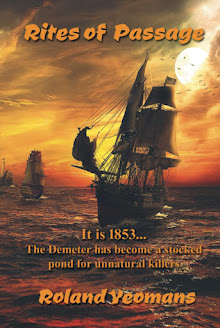
For RITES OF PASSAGE, I had to create the illusion of 1853 in such a way as to root my reader in the reality of that age without tuning him out.

I made Samuel McCord a man educated by his Harvard professor father and inhuman Jesuit priests. His travels across the world has made him a more open-minded man. He has the sensibilities of a 21st century man at odds with the 19th century world.

Therefore, the reader can identify with him as he locks horns with the accepted status quo that offends his compassionate reasoning and the reader's modern sensibilities.
***

There was a TV series which highlights how the mindset and customs we take for granted are just a thing of the moment : LIFE ON MARS :